New JCB Fastrac 6300: Specs, Features and Best Uses
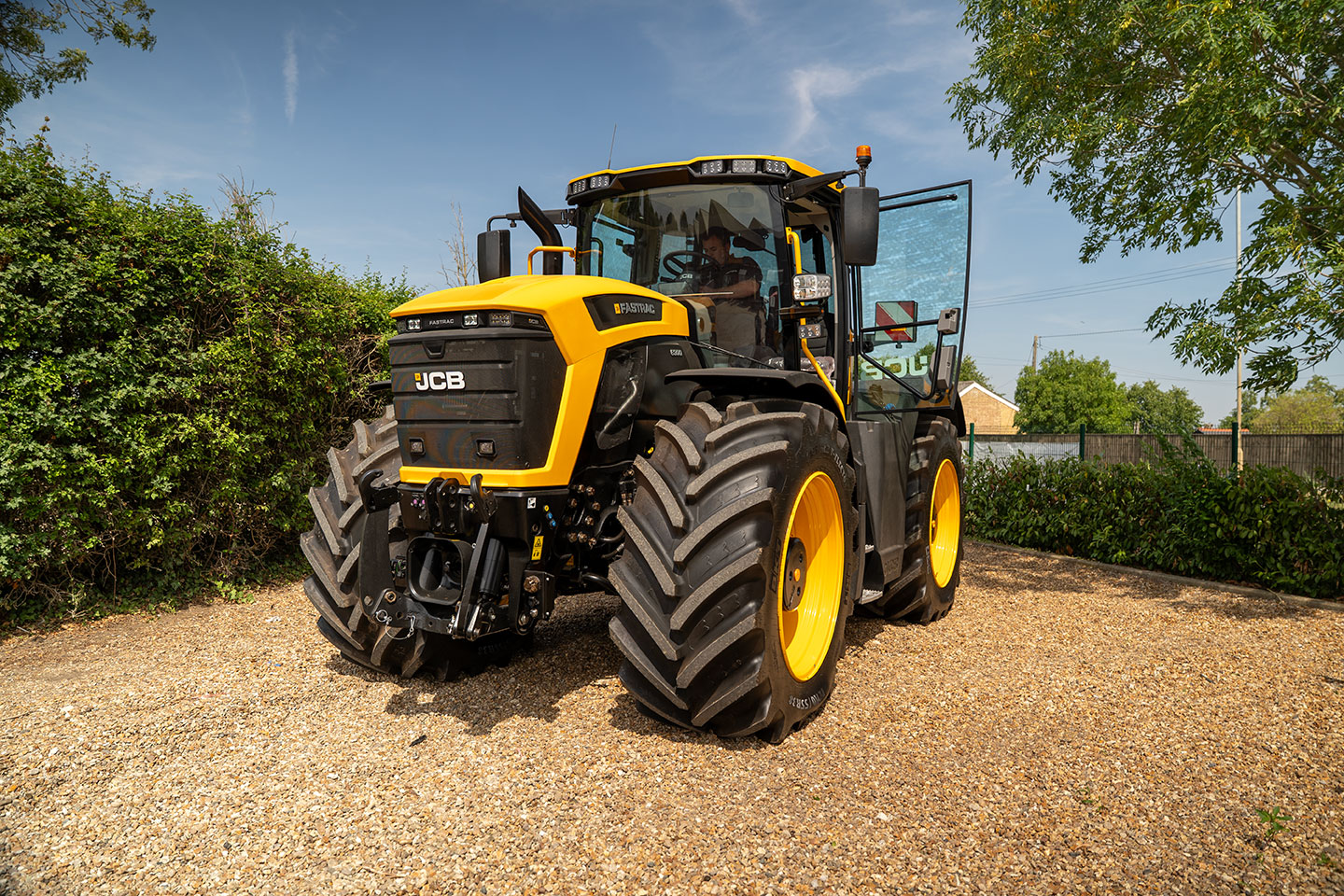
The new JCB Fastrac 6300 takes the Fastrac into a new power category, combining a rated output of 335hp with four-wheel steering, front and rear suspension and a maximum speed of up to 66kph.
However, power and road speed only tell part of the story.
The 6300 also offers an 11,000kg rear linkage, up to 410 litres per minute of hydraulic flow, a 5,000kg-capacity rear deck and new precision-farming technology. Together, these features position it as a serious field and transport tractor for large farms and agricultural contractors.
For arable, root-crop, vegetable and contracting businesses across Cambridgeshire, Norfolk, Suffolk and South Lincolnshire, the main question is whether the JCB Fastrac 6300’s combination of field capability and road performance fits the workload.
Is the JCB Fastrac 6300 right for your farm?
The JCB Fastrac 6300 is best suited to larger arable farms, agricultural contractors and specialist crop businesses needing one tractor for heavy fieldwork, high-capacity implements and regular road transport.
It is likely to be particularly relevant where the tractor will carry out several of the following jobs:
- cultivation and drilling;
- grain, potato or vegetable haulage;
- high-output mowing and forage work;
- spraying and fertiliser spreading;
- slurry and digestate application;
- operating large hydraulic implements;
- moving regularly between blocks of land or customer sites;
- carrying equipment or tanks on the rear deck.
A farm needing a smaller, lower-powered tractor primarily for yard or lighter field duties may struggle to use the 6300 fully. The machine makes the strongest case where its power, hydraulic capacity, implement mountings and road capability will all be used regularly.
JCB Fastrac 6300 specifications at a glance
| Specification | JCB Fastrac 6300 |
|---|---|
| Rated power | 335hp / 250kW |
| Maximum power | 335hp / 250kW |
| Maximum torque | 1,400Nm |
| Engine | 6.7-litre, six-cylinder FPT NEF67 |
| Transmission | ZF Eccom 3.1 stepless transmission |
| Maximum speed | Up to 66kph where permitted |
| Rear linkage capacity | 11,000kg |
| Optional front linkage capacity | 5,000kg |
| Standard hydraulic flow | 205 litres/min |
| Optional hydraulic flow | 410 litres/min |
| Rear deck capacity | 5,000kg |
| Steering | Multi-mode four-wheel steering |
| Rear PTO | Four-speed |
| Front PTO | Optional 1,000rpm |
These are JCB’s published figures for the current 6300. The exact specification should always be confirmed when ordering, particularly where optional hydraulics, front equipment, guidance or tyre-pressure management systems are required.
What is new about the JCB Fastrac 6300?
The 6300 is one of two tractors in the all-new Fastrac 6000 Series. It sits above the 284hp Fastrac 6260 and introduces a new chassis, engine and transmission combination, heavier-duty axles and updated steering, suspension, hydraulic and precision-farming systems.
Rather than simply placing a more powerful engine into an existing model, JCB has developed a new platform around the requirements of high-horsepower field and transport work.
New engine and stepless transmission
The Fastrac 6300 uses a 6.7-litre FPT NEF67 six-cylinder engine, producing 335hp and maximum torque of 1,400Nm.
JCB says at least 95 per cent of the maximum torque is available across an engine-speed range of 1,200 to 1,800rpm. In practical terms, this should help the tractor maintain performance when draft loads increase or when pulling a loaded trailer uphill.
The engine is paired with a ZF Eccom 3.1 stepless transmission. JCB’s Smart Transmission Control manages the relationship between engine speed and transmission behaviour, allowing the tractor to travel from zero to 66kph without the operator manually changing between field and road ranges.
Why does that matter?
For fieldwork, the operator can select a precise forward speed for drilling, cultivating or spreading.
On the road, the system can manage engine and transmission settings around the required travel speed. This is particularly relevant to businesses where the tractor moves regularly between fields, farms, stores or customer sites.
The ability to control travel through the joystick, accelerator pedal or thumb roller also lets operators choose the method that best suits the job.
Four-wheel steering on a 335hp tractor
One of the most significant features of the Fastrac 6300 is its multi-mode four-wheel steering.
Four-wheel steering is not new to the Fastrac range, but the 6000 Series introduces it into a higher power category. The system progressively changes between two-wheel and four-wheel steering according to forward speed.
At road speeds, the tractor operates in two-wheel steering for predictable high-speed behaviour. Four-wheel steering then becomes available at lower speeds for field turns, yards, gateways and junctions.
Practical benefits of four-wheel steering
Four-wheel steering can help with:
- reducing the space needed for headland turns;
- entering narrow field gateways with long implements;
- manoeuvring around yards and stores;
- following tramlines;
- working in row and bed systems;
- reducing the amount of corrective steering required with mounted equipment.
For East Anglian vegetable, potato and root-crop businesses, the steering modes may be particularly relevant where maintaining accurate wheel and implement positioning matters.
Twin Steer precision guidance
The Fastrac 6300 can also be equipped with JCB’s Twin Steer guidance system.
This uses two satellite receivers and controls the front and rear axles separately. When the tractor needs to correct its position, it can move crab-wise towards the guidance line rather than steering the front axle first and temporarily pushing the implement further off course.
JCB developed this system around applications such as sowing and working in accurately spaced vegetable and salad beds. It may also help maintain implement position on slopes or uneven ground.
The guidance package includes:
- twin satellite receivers;
- straight and curved guidance lines;
- automated headland-turn patterns;
- faster line acquisition;
- Twin Steer;
- optional GPS Rapid Steer;
- ISOBUS compatibility;
- section and variable-rate control options.
For operators already using precision farming equipment, compatibility with existing implements, correction services and farm-management systems should be checked before the tractor is specified.
Hydraulic performance for demanding implements
The standard hydraulic system provides up to 205 litres per minute.
On the Fastrac 6300, JCB also offers an optional twin-pump installation capable of up to 410 litres per minute. This is intended for implements with particularly high oil demands, such as large air seeders.
The hydraulic oil supply is separate from the transmission. This helps protect the transmission from contamination when the tractor is connected to different implements or shared machinery.
Who is likely to need the 410-litre hydraulic option?
The optional high-flow system is most relevant where the tractor will operate:
- large pneumatic seed drills;
- high-capacity planters;
- specialist vegetable equipment;
- hydraulic-driven fans or pumps;
- equipment using several hydraulic functions simultaneously;
- implements where hydraulic performance currently limits output.
Not every buyer will need it. Farms using more conventional mounted or trailed equipment may find the standard 205-litre system sufficient.
The hydraulic requirement of each principal implement should therefore be checked before specifying the tractor.
Rear linkage, front linkage and rear deck
The Fastrac 6300 has an 11,000kg-capacity rear three-point linkage.
An optional 5,000kg front linkage and 1,000rpm front PTO can also be specified. At the rear, the four-speed PTO provides additional flexibility for different implements.
Behind the centrally positioned cab is a rear load deck with a maximum capacity of 5,000kg. This creates a third equipment-mounting position alongside the front and rear linkages.
What can the rear deck be used for?
Depending on specification and permitted loading, possible uses include:
- demount sprayers;
- fertiliser or seed tanks;
- liquid tanks supplying a planter;
- ballast;
- specialist contracting equipment;
- additional storage or application equipment.
The rear deck can make the 6300 particularly useful for businesses wanting to create a dedicated spraying, spreading or planting unit without permanently tying the tractor to one application.
Equipment weight, centre of gravity, axle loading and overall vehicle weight must still be checked carefully.
Central tyre inflation system
A fully integrated central tyre inflation system is available on the Fastrac 6300.
It allows the operator to alter tyre pressures through the iCON display without leaving the cab. Lower field pressures can increase the tyre’s footprint and help with traction and soil protection. Higher road pressures can then be selected for stability, tyre life and transport efficiency.
JCB says its system can inflate four 650/60 R38 tyres from 1 bar to 2 bar in just over four minutes. Deflation back to a lower field pressure takes less than one minute.
Where could CTIS be most useful?
The system is likely to offer the greatest benefit where a tractor repeatedly changes between field and road work during the same day.
Examples include:
- agricultural contracting;
- grain and potato haulage;
- travelling between separated blocks of land;
- drilling or cultivation followed by extended road travel;
- slurry and digestate work;
- vegetable businesses with land spread across several sites.
A tractor that spends almost all its time on one surface may gain less from the system. The benefit depends on how frequently the operator would otherwise need to compromise between field and road pressures.
Suspension, braking and road performance
Like other Fastracs, the 6300 has suspension at both the front and rear axles.
The new 6000 Series uses heavy-duty axles with advanced double-acting suspension and anti-roll bars. JCB combines this with a full-length rigid chassis, external disc brakes and ABS.
The result is a tractor designed to remain stable during fieldwork and at road speeds of up to 66kph, where local regulations and the complete vehicle combination allow.
What should buyers consider for road work?
Maximum tractor speed should not be considered in isolation.
Buyers should also assess:
- trailer speed rating;
- trailer braking system;
- tyre specification;
- implement and trailer weight;
- load security;
- route conditions;
- driver training;
- applicable agricultural vehicle regulations.
A tractor capable of 66kph only provides a useful transport advantage where the trailer, equipment, route and operating conditions are also suitable.
JCB iCON cab and controls
The Fastrac 6300 uses JCB’s iCON digital control system.
Operators can configure the touchscreen to show the information most relevant to a particular task, including tractor functions, cameras, guidance, ISOBUS controls and application information.
A second 12-inch display is available where more screen space is needed for guidance or complex implements. Operators can also save different tractor, implement and control profiles for future use.
Other available features include:
- configurable joystick controls;
- configurable spool-valve controls;
- front and rear cameras;
- push-button engine starting;
- engine immobiliser;
- JCB LiveLink telematics;
- ISOBUS implement control;
- section control;
- variable-rate application.
The value of these systems will depend on how many different operators and implements use the tractor. Farms should establish how easily settings can be saved, recalled and adjusted during a demonstration.
What work is the Fastrac 6300 best suited to?
Cultivation and drilling
With 335hp, 1,400Nm of torque and an 11,000kg rear linkage, the 6300 is firmly aimed at substantial field equipment.
Potential work includes:
- ploughing;
- primary and secondary cultivations;
- operating combination drills;
- pulling large pneumatic seeders;
- direct drilling;
- operating potato and vegetable planting equipment.
The optional 410-litre hydraulic package may be particularly relevant where seeders or planters place heavy demands on the tractor’s oil supply.
Implement width alone should not decide suitability. Draft requirement, working depth, weight, hydraulic demand and local soil conditions all need to be considered.
Large arable farms
The 6300 should suit arable businesses needing one high-horsepower tractor to divide its time between fieldwork and transport.
For example, the same tractor could carry out cultivations or drilling and then move onto grain trailers during harvest.
This is likely to be particularly relevant across Cambridgeshire, Norfolk, Suffolk and South Lincolnshire, where businesses may operate several blocks of land and travel meaningful distances between fields, stores and grain buyers.
JCB itself has positioned the 6300 for arable cultivation, drilling and transport operations.
Agricultural contractors
The Fastrac concept has always been relevant to contractors because travelling between customers is unavoidable non-working time.
The 6300 takes that principle into a higher power category. It could suit contractors carrying out:
- cultivation and drilling;
- forage work;
- baling;
- slurry or digestate application;
- spraying and spreading;
- grain and root-crop haulage;
- specialist vegetable work.
However, a contractor should be confident that the tractor will generate enough annual hours across several jobs. Buying it for one short seasonal operation may not make full use of its versatility.
Vegetable, potato and root-crop farms
The combination of four-wheel steering, Twin Steer guidance, rear-deck capacity and multiple implement-mounting positions may make the 6300 particularly interesting to specialist crop businesses.
Possible jobs include:
- potato and vegetable planting;
- bed cultivation;
- crop spraying;
- fertiliser placement;
- haulage;
- operating front-and-rear combinations;
- carrying additional seed or liquid tanks.
Accurate tracking and repeatable positioning can matter just as much as horsepower in these applications.
Grassland and forage work
The JCB Fastrac 6300 made its first public working appearance in the UK operating high-capacity grass equipment alongside the Fastrac 4220.
Its power, suspension and four-wheel steering can suit large mowers, tedders, balers and wrappers, particularly where the tractor also needs to travel regularly between farms or fields.
For many livestock farms, however, the 6300 will be larger than necessary. It is more likely to suit specialist forage contractors or large businesses able to use the tractor across grassland, fieldwork and haulage.
Road haulage
The 6300 is not simply a field tractor that can travel quickly.
Its suspended axles, ABS braking, stepless transmission and 66kph capability are designed around businesses where road work forms a substantial part of the annual workload.
Typical examples could include:
- grain haulage;
- potato and vegetable transport;
- forage trailer work;
- digestate and slurry applications;
- moving equipment between contracting customers;
- travelling between geographically separate farms.
The financial benefit will depend on route lengths, permitted speeds, loading time and the amount of the working day currently lost to travel.
Who is the JCB Fastrac 6300 best for?
The strongest prospects are likely to include:
- large arable farms;
- agricultural contractors;
- potato and root-crop growers;
- vegetable and salad businesses;
- high-output forage contractors;
- AD and digestate operations;
- farms spread across several blocks of land;
- businesses operating large hydraulic implements;
- operators wanting a high-power tractor with four-wheel steering.
Its strongest selling point is not one individual specification.
It is the ability to combine high-horsepower fieldwork, multiple implement positions, accurate guidance, substantial hydraulic capacity and high-speed transport in one tractor.
Who may not need a Fastrac 6300?
The 6300 may be difficult to justify where:
- most work is below the 250hp class;
- annual hours are relatively low;
- the tractor rarely travels on the road;
- buildings and yards restrict machine size;
- implements do not need the available linkage or hydraulic capacity;
- a Fastrac 4220 or 6260 would complete the same work;
- the machine would be used for only one short seasonal task.
A tractor that is technically capable of every farm job is not necessarily the one that will deliver the lowest cost per hour.
Utilisation remains central to the decision.
JCB Fastrac 6260 vs 6300
Both tractors use the same new 6000 Series platform, but the 6300 provides additional power, torque and an optional higher-output hydraulic system.
| JCB Fastrac 6260 | JCB Fastrac 6300 | |
|---|---|---|
| Rated power | 284hp | 335hp |
| Maximum torque | 1,275Nm | 1,400Nm |
| Rear linkage capacity | 11,000kg | 11,000kg |
| Optional front linkage | 5,000kg | 5,000kg |
| Standard hydraulic flow | 205 litres/min | 205 litres/min |
| Optional hydraulic flow | Not listed at 410 litres/min | 410 litres/min |
| Maximum speed | Up to 66kph | Up to 66kph |
| Best fit | High-power mixed field and transport work | Heavier implements and maximum 6000 Series output |
The 6260 is likely to be the more proportionate choice where 284hp comfortably meets the implement and transport requirements.
The 6300 becomes more relevant where the additional 51hp, higher torque and available twin-pump hydraulics can be used regularly.
JCB Fastrac 6300 vs 8330
The 6300 does not simply replace the larger-numbered Fastrac 8330.
The 6300 offers four-wheel steering, an 11,000kg rear linkage, up to 410 litres per minute of hydraulic flow and a maximum speed of 66kph.
The current 8330 places greater emphasis on maximum road speed, with up to 70kph, and has a published 10,000kg rear linkage. Its platform and steering arrangement are different from the new 6000 Series.
In practical terms:
- consider the 6300 where four-wheel steering, heavy mounted equipment and hydraulic demand are major priorities;
- consider the 8330 where maximum road performance and the established 8000 Series platform better suit the workload.
A detailed 6300 vs 8330 comparison should include both fieldwork and a representative road journey.
What has the Fastrac 6300 won?
The JCB Fastrac 6300 received the Sustainable Tractor of the Year award at Agritechnica in November 2025.
The wider Fastrac 6000 Series also received the Machine of the Year Gold Award at LAMMA in January 2026. Judges highlighted its all-round suspension, four-wheel steering, braking system and ability to combine field and road work.
Awards are not a substitute for testing the tractor on the farm. However, they do show that the machine’s new steering, suspension and tyre-management systems have attracted attention beyond JCB’s own product launch.
Questions to answer before buying a JCB Fastrac 6300
Will the tractor use 335hp regularly?
List the main implements and determine how many annual hours genuinely require the 6300’s full capability.
Does the farm need the optional 410-litre hydraulic system?
Check the flow requirements of drills, planters, fans, pumps and hydraulic motors.
How much time will it spend on the road?
Estimate annual road hours, travel distances and the routes used rather than simply noting that transport is important.
Will four-wheel steering solve a real problem?
Consider gateways, headlands, row systems, yard space and implement tracking.
Would central tyre inflation be used properly?
CTIS provides most value where the operator regularly changes between field and road conditions and adjusts pressures accordingly.
Will equipment be mounted on the rear deck?
Discuss equipment dimensions, connections, load distribution and axle limits before ordering.
Which precision systems must it work with?
Check guidance correction signals, ISOBUS implements, application software, variable-rate maps and existing farm data systems.
Would the Fastrac 6260 be sufficient?
The 6260 shares many of the same platform features. Buyers should establish whether the extra power and hydraulic option of the 6300 are genuinely required.
A practical Pecks view
“The 6300 is likely to interest businesses that want one high-horsepower tractor to cover both serious fieldwork and a lot of road travel. The 335hp figure gets attention, but the four-wheel steering, 11-tonne rear linkage, hydraulic options and tyre-pressure system are what could make the difference in day-to-day use. We would still start with the customer’s implements, transport distances and annual hours, then put the tractor to work on the farm before deciding.”
This proposed quote should be checked and approved by the named Pecks employee before publication.
Why an on-farm demonstration matters
The Fastrac 6300 has several features that cannot be assessed properly from a specification sheet.
A useful demonstration should include:
- connecting one of the farm’s main implements;
- testing hydraulic functions;
- operating at the intended field speed;
- completing headland turns;
- entering normal field gateways;
- driving a representative road route;
- trying two-wheel and four-wheel steering;
- testing guidance and ISOBUS functions;
- assessing cab controls and visibility;
- checking access to daily service points.
Where CTIS is being considered, the demonstration should also show the process of moving between field and road pressures.
Every regular operator should have an opportunity to use the tractor before a final specification is agreed.
JCB Fastrac 6300 dealer support across East Anglia
G & J Peck Ltd is an authorised JCB Agriculture dealer providing machinery sales, servicing, genuine parts and aftersales support across Cambridgeshire, South Lincolnshire, Norfolk and Suffolk.
Pecks supports JCB Fastrac customers through its depots at:
- Chatteris, supporting Cambridgeshire and South Lincolnshire;
- Dereham, supporting agricultural customers across Norfolk;
- Rendlesham, supporting farms and contractors across Suffolk.
The company can help buyers compare Fastrac models, select equipment and arrange a machinery demonstration. Pecks also provides workshop and mobile servicing, parts support and ongoing aftersales assistance.
Cambridgeshire and South Lincolnshire
Customers considering a new JCB Fastrac 6300 for sale in Cambridgeshire or South Lincolnshire can contact the Pecks agricultural sales team through its Chatteris head office.
Pecks Chatteris
Iretons Way
Chatteris
Cambridgeshire
PE16 6UZ
Telephone: 01354 699505
Norfolk
Pecks’ Dereham depot provides local JCB sales, parts and service support for farmers and contractors across Norfolk.
Pecks Dereham
Yaxham Road Industrial Estate
Greens Road
Dereham
Norfolk
NR20 3TG
Telephone: 01362 698698
Suffolk
Pecks’ Rendlesham depot supports agricultural machinery customers across Suffolk from Bentwaters Parks near Woodbridge.
Pecks Rendlesham
Bentwaters Parks
Rendlesham
Woodbridge
Suffolk
IP12 2TW
Telephone: 01728 441400
JCB Fastrac servicing, parts and aftersales support
A high-output tractor can be central to drilling, spraying, harvest transport and contracting schedules.
Dealer support should therefore form part of the buying decision rather than being considered only after delivery.
Pecks provides JCB servicing and repair support through its depot workshops and field-service operation. Genuine JCB parts are also available through the business’s parts departments and online ordering service.
Before ordering a Fastrac 6300, it is worth discussing:
- expected annual hours;
- service intervals;
- seasonal workloads;
- warranty and service options;
- software and guidance support;
- tyre and CTIS maintenance;
- parts availability;
- out-of-hours arrangements;
- replacement and ownership plans.
Should you buy a new JCB Fastrac 6300?
The JCB Fastrac 6300 should be considered where a business needs a genuine high-power tractor but does not want to choose between field capability and road performance.
Its combination of 335hp, four-wheel steering, an 11,000kg rear linkage, up to 410 litres per minute of hydraulic flow and 66kph road capability creates a broad potential workload.
That does not mean it will suit every large farm.
The 6300 is likely to work best where several of its capabilities can be used throughout the year, rather than where it is purchased solely for one implement or seasonal operation.
Farmers and contractors considering a JCB Fastrac 6300 for sale in East Anglia should speak to Pecks about their implements, transport distances, precision-farming requirements and expected annual hours before arranging an on-farm demonstration.
Frequently asked questions
How much horsepower does the JCB Fastrac 6300 have?
The JCB Fastrac 6300 has a published rated and maximum output of 335hp, or 250kW.
It produces maximum torque of 1,400Nm.
What engine is in the JCB Fastrac 6300?
The Fastrac 6300 uses a 6.7-litre FPT NEF67 six-cylinder diesel engine.
JCB pairs the engine with a ZF Eccom 3.1 stepless transmission.
What is the top speed of the JCB Fastrac 6300?
JCB quotes a maximum speed of up to 66kph, or approximately 41mph, where local legislation permits.
The complete tractor, trailer or implement combination must be suitable for the speed being used
What is the rear lift capacity of the Fastrac 6300?
The Fastrac 6300 has a published rear three-point linkage capacity of 11,000kg.
An optional front linkage with a capacity of 5,000kg is also available.
What is the hydraulic flow of the JCB Fastrac 6300?
The standard hydraulic system provides up to 205 litres per minute.
An optional twin-pump system providing up to 410 litres per minute is available for the Fastrac 6300.
Does the JCB Fastrac 6300 have four-wheel steering?
Yes. The 6300 has selectable multi-mode four-wheel steering.
The system progressively moves between two-wheel and four-wheel steering according to vehicle speed.
Is central tyre inflation standard on the Fastrac 6300?
JCB describes the integrated central tyre inflation system as an available option on the new 6000 Series.
It allows tyre pressures to be altered from the cab for field and road work.
Is the JCB Fastrac 6300 suitable for cultivation?
Yes. Its 335hp output, 1,400Nm of torque, 11,000kg rear linkage and available high-flow hydraulics make it relevant to substantial cultivation and drilling equipment.
The implement’s draft, weight and hydraulic requirements should still be checked against the complete tractor specification.
Is the JCB Fastrac 6300 suitable for agricultural contracting?
The 6300 should suit contractors combining high-power field operations with regular road travel between customers.
Likely applications include drilling, cultivation, forage work, spraying, spreading and agricultural haulage.
What is the difference between the JCB 6260 and 6300?
The 6260 produces 284hp and 1,275Nm of torque.
The 6300 produces 335hp and 1,400Nm and can be equipped with the optional 410-litre-per-minute hydraulic package. Both have an 11,000kg rear linkage, four-wheel steering and a maximum speed of up to 66kph.
Can Pecks arrange a JCB Fastrac 6300 demonstration?
Pecks supports customers through machinery selection, specification, delivery, servicing and aftersales. Buyers can speak to the JCB sales team about demonstration availability for the Fastrac model they are considering.
Where can I buy a JCB Fastrac 6300 in Cambridgeshire?
Pecks’ Chatteris head office provides JCB machinery sales, parts and service support for customers in Cambridgeshire and the surrounding area.
Contact Pecks Chatteris on 01354 699505.
Where can I buy a JCB Fastrac 6300 in Norfolk?
Pecks’ Dereham depot supports agricultural machinery customers across Norfolk.
Contact Pecks Dereham on 01362 698698.
Where can I buy a JCB Fastrac 6300 in Suffolk?
Pecks’ Rendlesham depot provides machinery sales, parts and servicing support for customers across Suffolk.
Contact Pecks Rendlesham on 01728 441400.
Does Pecks service JCB Fastrac tractors?
Yes. Pecks has dedicated service centres at each depot and more than 50 specialist engineers supporting agricultural machinery customers.
Can Pecks supply genuine JCB parts?
Yes. Pecks supplies genuine JCB parts through its parts departments and online ordering service, with click-and-collect and delivery options available.