
Kubota M5 vs M6 vs M7: Which Tractor Is Right for Your Farm?
The Kubota M5, M6 and M7 ranges overlap in some areas, but they are intended for different workloads.
An M5 can make a practical loader, livestock or support tractor. The M6 range moves into broader mixed-farm work, with enough choice to cover regular loader duties, fieldwork and transport. The M7 is aimed more towards businesses needing a main field tractor for heavier implements, haulage and higher annual workloads.
Choosing between them is not simply a matter of buying as much horsepower as the budget allows. The tractor needs to suit the implements it will operate, the amount of road work involved, the spaces it must work in and the jobs that will account for most of its hours.
This guide compares the Kubota M5, M6 and M7 ranges for farms and contractors across Cambridgeshire, Norfolk, Suffolk, South Lincolnshire and the wider East Anglia region.
Kubota M5, M6 or M7: the direct answer
Choose a Kubota M5 if you need a straightforward tractor for loader work, livestock duties, grassland, yard work and lighter field operations.
Look at the Kubota M6 if you need a versatile all-round tractor capable of combining loader work, fieldwork and transport. For many mixed and livestock farms, this is likely to be the strongest middle ground.
Consider a Kubota M7 if the tractor will carry out heavier fieldwork, operate larger implements, spend significant time on the road or work as a main tractor on a larger arable, mixed or contracting business.
| If your main requirement is… | Range to consider first |
|---|---|
| Loader, livestock and everyday yard work | Kubota M5 |
| A support tractor for a larger farming business | Kubota M5 or M6 |
| One tractor for loader work, fieldwork and transport | Kubota M6 |
| A main tractor for a medium mixed farm | Kubota M6 |
| Regular haulage and heavier field operations | Kubota M6 or M7 |
| A main arable tractor | Kubota M7 |
| Higher-output contracting work | Kubota M7 |
| KVT continuously variable transmission | Kubota M7 |
For many buyers, the M6 is the natural starting point because it sits between the general-purpose M5 and the larger M7. However, the M6 name covers two distinct ranges, the M6001 Utility and M6002, so the exact model still matters.
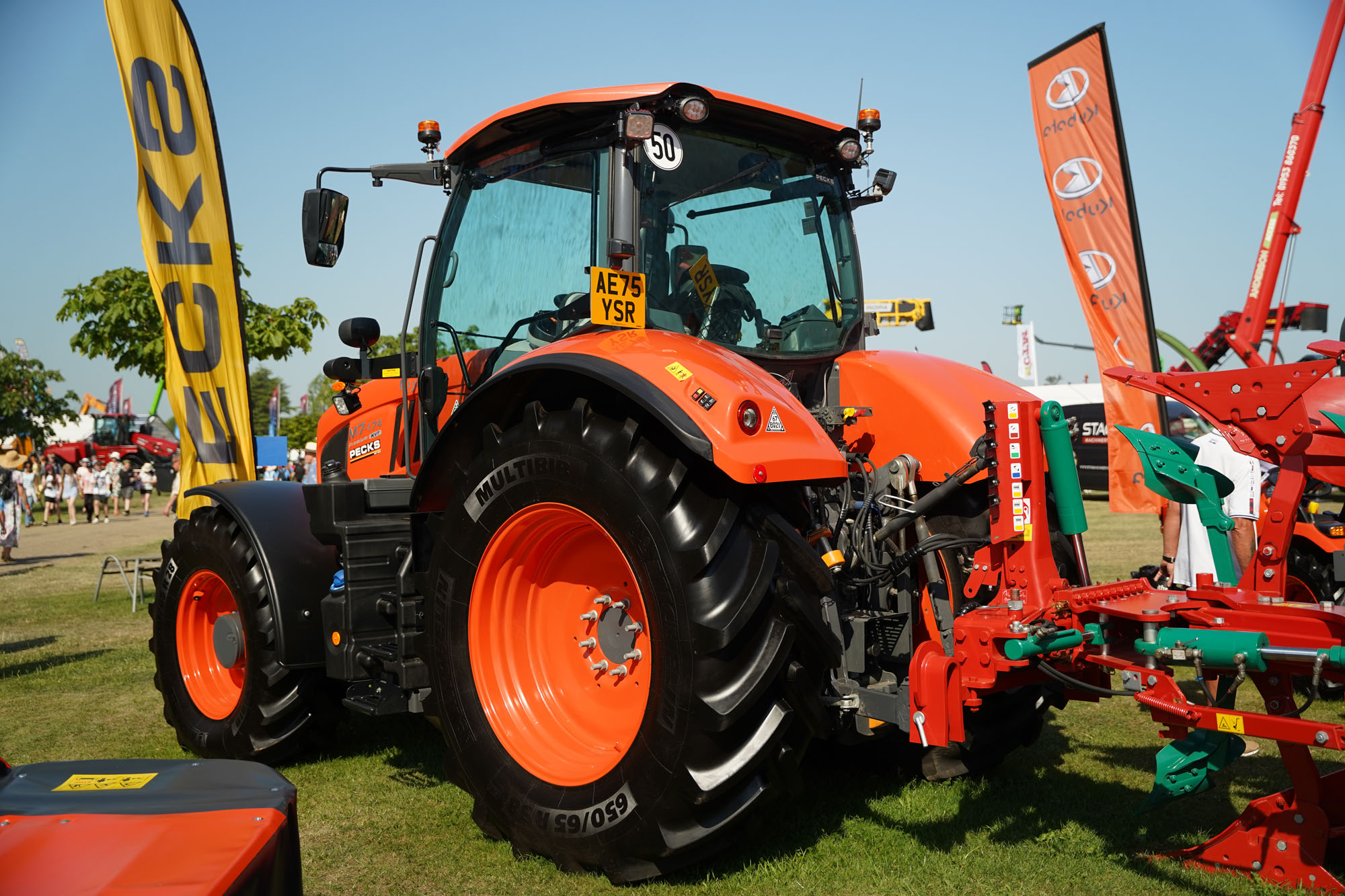
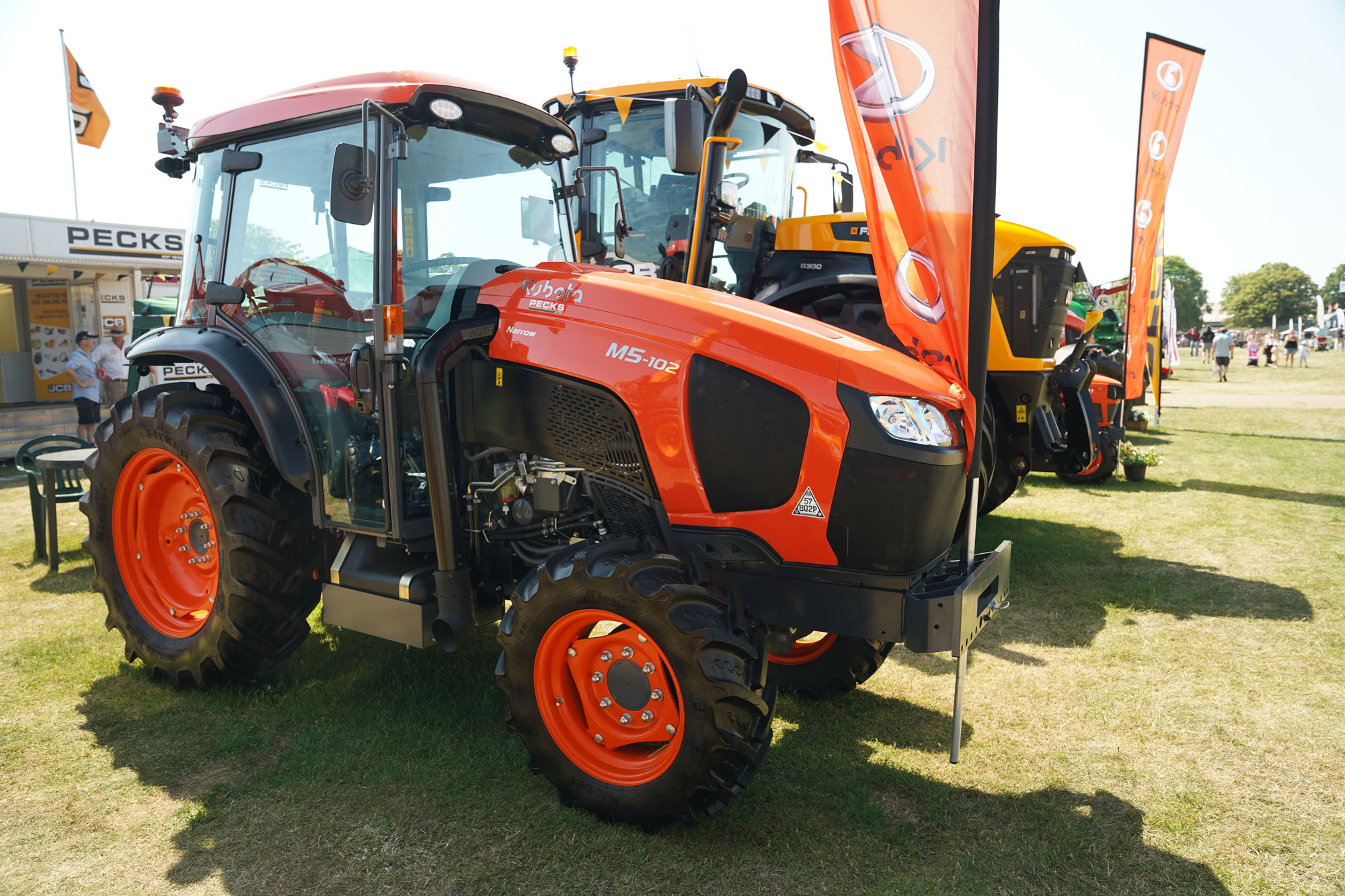
Kubota M5 tractor overview
The current Kubota M5002 range includes the M5-092 and M5-112, with published power figures of 95hp and 115hp respectively. Both use Kubota’s four-cylinder V3800 engine.
The M5 sits at the lower-powered end of this comparison, but that does not make it limited to occasional or light use. Its appeal is that it can cover a useful range of everyday farm jobs without moving into the size, specification or cost of a larger main tractor.
Typical M5 work could include:
- operating a front loader;
- feeding livestock;
- moving bales;
- topping and mowing;
- fertiliser spreading;
- light cultivations;
- operating a diet feeder;
- yard scraping;
- trailer work;
- general estate and farm maintenance.
The M5 is particularly relevant where the tractor needs to work around buildings, livestock yards or smaller fields, or where it will support a larger tractor during busy periods.
Who is the Kubota M5 best for?
The strongest prospects are likely to include:
- beef and livestock farms;
- smaller and medium-sized dairy farms;
- mixed farms needing a second tractor;
- poultry and pig units;
- grassland businesses;
- estates;
- equestrian operations;
- specialist growers;
- farms wanting a dedicated loader tractor.
It may also suit larger arable businesses looking for a smaller tractor to handle yard duties, fertiliser, seed, mowing or other support work.
Where does the Kubota M5-112 fit?
The 115hp M5-112 sits at the top of the M5002 range. It is likely to appeal to buyers who want the practicality of an M5 but need more power for field, PTO and transport work than the M5-092 provides.
For a farm where loader work and general duties remain the priority, it may provide a better fit than stepping immediately into a larger tractor.
Kubota M6 tractor overview
The Kubota M6 range needs a little more explanation because there are two different product families:
- Kubota M6001 Utility
- Kubota M6002
They occupy a similar general horsepower bracket, but their positioning and specification are not identical.
Kubota M6001 Utility
The M6001 Utility range runs from the M6-101U to the M6-141U, covering published power outputs from 104hp to 143hp.
It uses a 24-forward and 24-reverse Intelli-Shift transmission, with an optional creeper group increasing this to 32 forward and 32 reverse gears. Depending on the model, Kubota quotes rear linkage capacity of either 5,000kg or 6,100kg.
The M6001 Utility is positioned as a professional all-round tractor. It combines a conventional powershift transmission with loader integration, useful hydraulic capacity and a choice of models covering a broad range of farm duties.
Who is the Kubota M6001 Utility best for?
The range is particularly relevant to:
- dairy farms;
- beef and livestock farms;
- mixed farms;
- loader-intensive operations;
- straw and forage businesses;
- farms wanting a straightforward main or second tractor;
- operators who prefer conventional controls and powershift transmission.
An M6-131U, for example, can sit comfortably between a general-purpose M5 and a more field-focused M7. It provides a step up in power and capability while remaining suitable for regular loader and yard duties.
Kubota specifically identifies extensive dairy and livestock farms, cereal businesses and municipal users among the applications for the M6001 Utility.
Kubota M6002
The M6002 range includes the M6-122, M6-132 and M6-142.
Kubota publishes maximum power without boost of 123hp, 133hp and 143hp respectively. With power boost, the corresponding maximum figures are 143hp, 153hp and 163hp. The range uses a 24-forward and 24-reverse powershift transmission as standard, with an optional creeper group.
Compared with the M6001 Utility, the M6002 places greater emphasis on demanding fieldwork, road transport, heavier payloads and operator comfort over longer working days.
It still retains the manoeuvrability and loader capability required by livestock and mixed farms. This gives it a particularly useful position for businesses that do not necessarily need an M7 but regularly ask more of their tractor than general yard and support work.
Who is the Kubota M6002 best for?
The strongest applications include:
- medium and large dairy farms;
- mixed livestock and arable farms;
- farms carrying out regular trailer work;
- forage and grassland businesses;
- agricultural contractors;
- businesses using heavier mounted or trailed implements;
- operators wanting a tractor that can move between yard, road and field work.
Kubota describes the M6002 as being suited to mixed, dairy and cattle farms, with its transmission designed for both fieldwork and faster haulage applications.
Kubota M7 tractor overview
The current M7004 range includes the M7-134, M7-154 and M7-174.
Kubota publishes maximum power figures of 130hp, 150hp and 170hp, increasing to 150hp, 170hp and 175hp respectively with boost. Transmission options include K-Power powershift and KVT continuously variable transmission.
The M7 is the range to consider when the tractor is expected to do a greater proportion of demanding fieldwork, operate larger equipment or cover substantial road mileage.
Typical jobs include:
- cultivations;
- drilling;
- mowing and forage work;
- baling;
- muck and slurry spreading;
- crop protection and fertiliser applications;
- grain and root-crop haulage;
- operating larger PTO-driven implements;
- higher-output contracting work.
The M7004 also moves further into precision farming, implement management and automated guidance. Kubota offers K-Monitor options, autoguidance and Tractor Implement Management technology within the range.
Who is the Kubota M7 best for?
Likely buyers include:
- medium and large arable farms;
- larger mixed farms;
- agricultural contractors;
- root-crop and vegetable businesses;
- forage contractors;
- farms carrying out substantial haulage;
- operations wanting a higher-specification main tractor;
- businesses looking for KVT transmission.
For an East Anglian arable business, an M7 could become the main tractor for cultivations, drilling, transport and general field operations. On mixed farms, it may carry out the heavier fieldwork while an M5 or M6 covers loader and yard duties.
Kubota M5 vs M6 vs M7 comparison
| Kubota M5 | Kubota M6 | Kubota M7 | |
|---|---|---|---|
| Current range | M5002 | M6001 Utility and M6002 | M7004 |
| Example models | M5-092, M5-112 | M6-131U, M6-132, M6-142 | M7-134, M7-154, M7-174 |
| Published power range | 95hp to 115hp | 104hp to 143hp before applicable boost | 130hp to 170hp before boost |
| General role | Loader, livestock, yard and lighter field work | Mixed farm all-rounder | Main field and transport tractor |
| Typical buyer | Livestock, smaller mixed farm, estate or support-tractor user | Dairy, mixed, livestock and contracting businesses | Arable, larger mixed farms and contractors |
| Loader work | Strong application | Strong application, particularly M6001 Utility | Possible, but normally not the main reason for choosing it |
| Transport work | General trailer duties | Regular road and trailer work | Higher-output haulage |
| Fieldwork | Lighter and medium operations | Broad fieldwork capability | Heavier implements and higher workloads |
| Transmission direction | Straightforward general-purpose configuration | Powershift-based M6001 Utility and M6002 | K-Power or KVT |
| Main buying priority | Practicality and everyday versatility | Balance of manoeuvrability, power and capability | Field output, transport and higher specification |
Power figures do not always tell the whole story. Some published figures include temporary boost while others are quoted without it. Implement requirements, tractor weight, gearing, hydraulic performance and transmission choice can be more important than comparing the largest horsepower number in a brochure.
Which Kubota tractor is best for loader work?
Start with the M5 or M6001 Utility
For regular loader duties, the M5 and M6001 Utility are the first ranges to assess.
A livestock or mixed farm may need the tractor to load feed, shift bales, scrape yards, unload deliveries and then move directly into field or trailer work. In that situation, visibility, manoeuvrability, control layout and how well the tractor and loader work together matter more than maximum horsepower.
Kubota designs matched front loaders for both the M5002 and M6001 Utility ranges. The M6001 Utility also includes a roof window to improve the operator’s view of a raised loader.
The M7 can be specified with a loader, but it is usually being bought for a broader or more demanding field and transport workload. A larger tractor should not be selected for loader work alone unless its extra capacity and capability are genuinely needed elsewhere.
Which Kubota tractor is best for a dairy farm?
M5 for general yard work
An M5 can be a practical choice for feeding, bedding, bale handling, topping, scraping and other daily yard duties.
It may work particularly well as a second tractor on a larger dairy unit, allowing the main tractor to remain available for field and haulage operations.
M6 for a wider dairy workload
Where the same tractor must handle a loader, feeder wagon, mower, baler, slurry equipment and trailers, the M6 is likely to be the stronger starting point.
The M6001 Utility suits buyers looking for a conventional, practical all-round tractor. The M6002 becomes more relevant where fieldwork, transport and heavier equipment account for a larger part of the working year.
M7 for heavier field and forage operations
Larger dairy or forage businesses may justify an M7 where the tractor will handle high-output mowing, slurry, haulage and other demanding operations.
However, it may still be more efficient to pair the M7 with a smaller M5 or M6 for routine yard work.
Which Kubota tractor is best for a mixed farm?
The M6 is likely to be the strongest starting point
Mixed farms often ask one tractor to cover the widest range of work.
It may need to handle livestock tasks during winter, operate grassland equipment in spring, pull trailers during harvest and carry out cultivations or drilling at other points in the year.
This is the type of workload where the Kubota M6 range makes a strong case.
The M6001 Utility suits farms prioritising loader integration, manoeuvrability and straightforward operation. The M6002 is the more natural choice where heavier fieldwork and transport are regular parts of the job.
An M5 may still be sufficient for a smaller operation or second-tractor role, while an M7 becomes relevant where the arable or contracting side of the business requires greater field capacity.
Which Kubota tractor is best for an arable farm?
M5 as a support tractor
The M5 can work well for:
- fertiliser spreading;
- seed and pallet handling;
- topping;
- yard duties;
- light trailer work;
- running smaller PTO equipment.
It is unlikely to be the main cultivations tractor on a larger arable unit, but that does not make it any less useful. Keeping routine work away from a larger tractor can be operationally and financially sensible.
M6 for mixed field and transport work
The M6 suits arable farms using medium-sized implements or needing a tractor that can switch between fieldwork, loader duties and transport.
The M6002 is particularly relevant where significant road work or heavier mounted and trailed equipment is involved.
M7 as the main arable tractor
For larger acreages and more demanding equipment, the M7 is likely to be the first range to assess.
Its power, transmission choices, hydraulic specification and precision-farming options are more closely aligned with main-tractor duties such as cultivation, drilling, spraying, spreading and haulage.
Across Cambridgeshire, Norfolk, Suffolk and South Lincolnshire, the final decision will depend as much on cropping, field size, transport distance and existing machinery as it does on total acreage.
Which Kubota tractor is best for agricultural contractors?
Contractors should start with the work that generates most of the tractor’s hours and revenue.
An M6 may be the better fit for a business covering a mixture of loader work, grassland, bales, muck, slurry and general farm duties.
The M7 becomes more relevant when heavier fieldwork, high-output forage operations or frequent road haulage dominate the workload.
Transport requirements deserve particular attention. A tractor that spends a substantial proportion of its working life travelling between farms may need a different transmission and specification from one that stays predominantly within a single holding.
What is the difference between the M6001 Utility and M6002?
This is an important distinction because both sit within the wider M6 family.
Kubota M6001 Utility
The M6001 Utility is the more conventional multi-purpose range.
It offers:
- models from 104hp to 143hp;
- a 24-forward and 24-reverse Intelli-Shift transmission;
- matched Kubota loader options;
- a choice of smaller and larger chassis models;
- rear linkage capacity of up to 6,100kg, depending on model;
- a strong focus on manoeuvrability and straightforward farm use.
Kubota M6002
The M6002 moves the emphasis towards:
- a 6.1-litre four-cylinder engine;
- power boost for transport applications;
- heavier field and haulage work;
- higher hydraulic performance;
- longer working days;
- a more integrated multifunction control layout.
In practical terms, the M6001 Utility may appeal more to buyers wanting a straightforward loader and general farm tractor. The M6002 is likely to be the stronger fit where road work, heavier implements and field performance carry more weight in the decision.
Questions to answer before choosing an M5, M6 or M7
What implements will the tractor operate?
List the actual mower, baler, drill, cultivator, feeder wagon, spreader, sprayer and trailers the tractor will use.
Do not rely solely on the implement’s minimum power requirement. Weight, hydraulics, PTO demand, linkage capacity and stability also matter.
How much loader work is involved?
Regular loader use places a greater emphasis on visibility, shuttle operation, turning circle, attachment compatibility and loader controls.
A tractor chosen mainly for field power may not automatically be the best yard machine.
How much time will it spend on the road?
Transport distance, trailer size, braking requirements, road speed and operator comfort become increasingly important as road hours increase.
This can be one of the main reasons to move from an M5 towards an M6, or from an M6 into an M7.
Is it the main tractor or a support tractor?
A 110hp support tractor and a 110hp main tractor may be expected to do very different jobs.
The support tractor may prioritise loader work and manoeuvrability. The main tractor may need greater implement compatibility, comfort, hydraulics and transmission capability.
How important is transmission choice?
A conventional powershift may suit an operator who values familiarity and direct control.
For work involving variable field speeds, repeated transport or long operating days, the KVT continuously variable transmission available within the M7 range may deserve consideration.
The correct choice depends on the work and the operator, not simply which transmission carries the higher specification.
Will precision farming be used?
Guidance, ISOBUS, section control, variable-rate application and implement management should be discussed before the tractor is ordered.
Kubota currently offers its GEOPILOT automated steering system for M6 and M7 tractors, alongside terminal and GEOCONTROL options.
Is the current tractor regularly at its limit?
Occasionally needing more power does not necessarily justify moving up a complete tractor range.
Regularly struggling with implements, hills, payloads or transport work is a different matter. That may indicate that the current machine no longer matches the operation.
A Pecks view: start with the work, not the horsepower
“When someone asks us whether they need an M5, M6 or M7, we start with the jobs rather than the badge on the bonnet. The implements, amount of road work, loader use and annual hours usually point us in the right direction. An M5 can make a very useful yard and livestock tractor, the M6 is a strong all-round option for many mixed farms, and the M7 starts to make more sense when heavier fieldwork and transport account for a bigger share of the workload. A demonstration on the customer’s own farm is often the quickest way to confirm it.”
This is a proposed employee quote. It should be approved by the named employee before it is attributed to them.
Why a farm demonstration matters
A tractor may appear right on paper but feel very different when connected to the equipment it will actually operate.
An on-farm demonstration gives the buyer and operators an opportunity to assess:
- access into buildings and yards;
- visibility;
- turning space;
- loader operation;
- implement compatibility;
- control layout;
- transmission behaviour;
- road performance;
- operator comfort;
- performance in local soil and field conditions.
Where possible, connect the tractor to one or two of the farm’s main implements rather than limiting the demonstration to an unladen drive around the yard.
It is also worth asking every regular operator to try it. A tractor doing high annual hours needs to suit more than the person signing the order.
Kubota tractor dealer support across East Anglia
G & J Peck Ltd became a Kubota agricultural dealer from 1 December 2025, covering Cambridgeshire, Norfolk, Suffolk and South Lincolnshire.
Pecks provides sales, service and aftercare for Kubota’s agricultural range, with tractors extending from the 25hp EK1-261 to the 175hp M7-174 KVT Premium.
Support is available through Pecks’ depots at Chatteris, Dereham and Rendlesham.
Kubota tractors in Cambridgeshire and South Lincolnshire
Customers looking for a Kubota tractor dealer in Cambridgeshire or South Lincolnshire can contact Pecks’ Chatteris head office.
The depot has agricultural sales, parts and service departments, along with workshop and out-of-hours support arrangements.
Pecks Chatteris
Iretons Way
Chatteris
Cambridgeshire
PE16 6UZ
Telephone: 01354 699505
Kubota tractors in Norfolk
Pecks’ Dereham depot supports agricultural customers across Norfolk.
Farmers and contractors looking for a Kubota M5, M6 or M7 for sale in Norfolk can speak to the local team about current machinery, specification, servicing and demonstration availability.
Pecks Dereham
Yaxham Road Industrial Estate
Dereham
Norfolk
NR20 3TG
Telephone: 01362 698698
Kubota tractors in Suffolk
Pecks’ Rendlesham depot provides a local sales, service and parts contact for customers in Suffolk.
Buyers comparing Kubota tractors for mixed, livestock, estate or arable work can contact the team to discuss the appropriate model and arrange a demonstration.
Pecks Rendlesham
Bentwaters Parks
Rendlesham
Woodbridge
Suffolk
IP12 2TW
Telephone: 01728 441400
Kubota servicing, parts and aftersales support
Dealer support should form part of the tractor comparison.
The machine may be central to feeding, fieldwork or harvest, so access to servicing, technical assistance and the correct parts matters throughout ownership.
Pecks provides agricultural machinery servicing and aftercare through its depot and mobile support operation. Genuine Kubota parts can also be ordered online, with click and collect or delivery options available.
Before ordering a tractor, it is worth discussing:
- planned service intervals;
- expected annual hours;
- warranty options;
- seasonal support;
- parts availability;
- telematics and service monitoring;
- likely replacement cycle.
These considerations may not change which model is suitable, but they can influence the exact specification and ownership plan.
Which Kubota tractor is right for your farm?
Choose a Kubota M5 if:
- loader and yard duties make up much of the workload;
- you need a practical livestock or grassland tractor;
- it will support a larger main tractor;
- it regularly works around buildings or confined spaces;
- lighter field and PTO work is sufficient;
- simplicity and everyday usability are priorities.
Consider a Kubota M6001 Utility if:
- you need a versatile loader and general farm tractor;
- livestock, grassland and mixed-farm work dominate;
- a conventional powershift transmission suits your operators;
- manoeuvrability remains important;
- the tractor will cover both yard and field jobs.
Consider a Kubota M6002 if:
- fieldwork and transport form a greater part of the workload;
- more power is required without moving directly to an M7;
- the tractor will handle heavier implements and payloads;
- it needs to combine loader work with longer field days;
- mixed, dairy or contracting duties require a stronger all-round package.
Choose a Kubota M7 if:
- it will be a main arable or contracting tractor;
- heavier cultivations, drilling or haulage are regular jobs;
- road work makes up a significant number of hours;
- KVT transmission is required;
- precision farming and implement management are priorities;
- the business needs the upper end of Kubota’s current agricultural tractor range.
The final choice should be based on the tractor’s main workload, rather than its most demanding occasional job.
Arrange a Kubota tractor demonstration in East Anglia
Pecks supplies Kubota agricultural tractors across Cambridgeshire, Norfolk, Suffolk and South Lincolnshire, with local sales, parts, servicing and aftersales support.
Customers can view Pecks’ current selection of new, used and demonstration Kubota tractors, including models from the M5, M6 and M7 ranges.
Speak to the Pecks team about your current tractor, implements and workload, or arrange an on-farm demonstration of the Kubota model you are considering.
Frequently asked questions
A quick rundown of the questions we hear most. Reach out anytime if yours isn’t covered here.
Which Kubota tractor should I buy?
Choose the tractor around its regular workload.
The M5 is a strong starting point for loader, livestock, yard and lighter field duties. The M6 suits buyers wanting a broader all-round machine for loader work, fieldwork and transport. The M7 is more appropriate where heavier implements, haulage and main-tractor work dominate.
A demonstration using your own implements is the best way to confirm the choice.
What is the difference between a Kubota M5 and M6?
The M5 occupies the lower-powered end of the agricultural M-series covered here, with current M5002 models at 95hp and 115hp.
The M6 range extends further in power and capability, with greater choice for loader work, heavier field operations and transport. It also includes two distinct ranges, the M6001 Utility and M6002.
What is the difference between the Kubota M6001 Utility and M6002?
The M6001 Utility is positioned as a manoeuvrable professional all-round tractor with a 24F/24R Intelli-Shift transmission and matched loader options.
The M6002 places more emphasis on demanding fieldwork, higher-speed transport, heavier payloads and power boost. It is likely to suit farms where road and field duties account for a greater share of the tractor’s hours.
Which Kubota tractor is best for a mixed farm?
For many mixed farms, an M6 is likely to be the strongest starting point.
The M6001 Utility suits loader-intensive livestock and general farm work. The M6002 is more relevant where heavier fieldwork and transport are also regular requirements.
Smaller farms or those needing a second tractor should still consider the M5.
Which Kubota tractor is best for an arable farm?
An M5 can make a useful support tractor for fertiliser, seed, yard and lighter field duties.
The M6 suits medium field and transport work, while the M7 is the range to consider for heavier cultivations, drilling, haulage and main-tractor duties.
Is the Kubota M7 available with a continuously variable transmission?
Yes. Kubota offers the current M7004 range with either K-Power or KVT transmission, depending on the model and specification.
Can Kubota M5 and M6 tractors be fitted with loaders?
Yes. Kubota offers matched front loaders for its M5002, M6001 Utility and M6002 tractor ranges. The exact loader and specification should be matched to the tractor and intended work.
Does the horsepower figure include boost?
It depends on the model and how the figure is presented.
For example, Kubota publishes both maximum power without boost and maximum power with boost for the M6002 and M7004 ranges. Buyers should compare like-for-like figures and discuss PTO, drawbar and transport requirements for the exact model.
Where can I buy a Kubota tractor in Cambridgeshire?
Pecks is an authorised Kubota agricultural dealer covering Cambridgeshire, with its head office, sales, parts and service operation at Chatteris.
Contact Pecks Chatteris on 01354 699505 to discuss Kubota tractors for sale and demonstration availability.
Where can I buy a Kubota tractor in Norfolk?
Pecks’ Dereham depot supports agricultural customers in Norfolk.
Contact Pecks Dereham on 01362 698698 to discuss current Kubota tractor stock, servicing and demonstrations.
Where can I buy a Kubota tractor in Suffolk?
Pecks’ Rendlesham depot provides Kubota sales, parts and service support for customers in Suffolk.
Contact Pecks Rendlesham on 01728 441400 to discuss M5, M6 and M7 tractors and arrange a demonstration.
Does Pecks service Kubota tractors?
Yes. Pecks provides agricultural machinery servicing, repairs and aftersales support through its depot and mobile service operations.
Customers can contact the service department at Chatteris, Dereham or Rendlesham.
Can I buy genuine Kubota tractor parts from Pecks?
Yes. Genuine Kubota parts can be ordered through Pecks, including through its online Kubota parts service. Click and collect and delivery options are available.
Can Pecks arrange a Kubota tractor demonstration?
Customers considering a new Kubota tractor can contact their local Pecks sales team to discuss demonstration availability.
An on-farm demonstration is particularly useful when comparing the M5, M6 and M7 because the tractor can be assessed with the buyer’s own buildings, trailers, implements and field conditions.