Kubota M5-112 vs M6-131U: Which Tractor Is Right for Your Farm?
The Kubota M5-112 and M6-131U can both suit mixed and livestock farms, but they occupy different positions in the Kubota tractor range.
The M5-112 is the smaller and lighter of the two. It is well suited to loader work, feeding, livestock yards, grassland duties and general farm jobs. The M6-131U moves onto a larger chassis, with a larger engine, greater rear linkage capacity and more hydraulic output. That makes it more relevant where heavier implements, regular haulage and broader fieldwork form a substantial part of the workload.
The decision is therefore not simply whether the extra 18hp of the M6-131U would be useful. The more important question is whether the farm needs the additional size, weight and capability that come with it.
This practical comparison is written for farmers and agricultural businesses across Cambridgeshire, Norfolk, Suffolk, South Lincolnshire and the wider East Anglia region.
Kubota M5-112 or M6-131U: the direct answer
Choose the Kubota M5-112 if loader work, livestock duties, feeding, yard work and lighter field operations will account for most of the tractor’s hours.
Consider the Kubota M6-131U if the tractor also needs to handle heavier mounted equipment, larger trailers, more regular fieldwork or a greater proportion of road work.
For many livestock farms, the M5-112 will make a practical loader or second tractor. For a larger dairy or mixed farm wanting one machine to move between yard, field and transport work, the M6-131U may provide the stronger all-round package.
| If your priority is… | Tractor to consider first |
|---|---|
| Daily loader and livestock-yard work | Kubota M5-112 |
| Feeding, bedding and bale handling | Kubota M5-112 |
| Working regularly around tighter buildings | Kubota M5-112 |
| A support tractor for a larger farming business | Kubota M5-112 |
| One tractor for yard, field and road work | Kubota M6-131U |
| Heavier mounted or trailed implements | Kubota M6-131U |
| Regular haulage with larger trailers | Kubota M6-131U |
| A main tractor for a medium mixed farm | Kubota M6-131U |
The M6-131U is not merely an M5-112 with slightly more power. It has a larger 6.1-litre engine, a stronger rear linkage, greater hydraulic flow and a substantially heavier chassis. Those differences matter more than the model numbers alone suggest.
Not sure which tractor suits your workload?
The quickest way to decide is to assess the tractors using the farm’s own yard, trailers and implements.
Speak to the Pecks Kubota team about your current tractor and arrange an on-farm demonstration of the model you are considering.
[ARRANGE A KUBOTA DEMONSTRATION]
Kubota M5-112 overview
The Kubota M5-112 is the larger of the two standard M5002 models.
Kubota publishes a rated output of 115hp from its 3,769cc four-cylinder V3800 engine. The tractor uses a 36-forward and 36-reverse transmission with Dual Speed, an electro-hydraulic shuttle and a published top speed of 40km/h Eco.
Its combination of power, relatively compact dimensions and straightforward controls gives the M5-112 a broad range of possible roles.
Typical work could include:
- front-loader duties;
- feeding livestock;
- moving bales;
- bedding and yard work;
- topping and mowing;
- fertiliser spreading;
- operating a feeder wagon;
- light cultivations;
- general trailer work;
- operating smaller PTO-driven implements;
- supporting a larger tractor during busy periods.
The M5-112 is particularly relevant where the tractor must work in and around livestock buildings rather than spending its entire life in open fields.
What makes the M5-112 suitable for yard work?
Kubota gives the M5002 a bevel-gear front axle and a published wheelbase of 2.25m. The manufacturer quotes a turning radius of approximately 4.2m without braking, while the unballasted tractor weight is listed at 3,500kg.
In practical terms, it is the smaller and lighter machine in this comparison.
That can be useful where entrances are restricted, livestock buildings are closely spaced or the operator regularly needs to turn in a confined yard. A lighter tractor can also be preferable for some grassland and yard applications, although tyre choice, ballast and pressure remain important.
Kubota M5-112 hydraulics and linkage
Kubota quotes a hydraulic pump output of 64 litres per minute and a Category II rear linkage capacity of 4,100kg for the M5002. The standard PTO arrangement is 540 and 540 Eco, with 540 and 1,000rpm available as an option.
Those figures place the M5-112 firmly in the general-purpose livestock and mixed-farm category.
It can handle a useful range of mounted and PTO-driven equipment. However, farms using particularly heavy implements should check the complete implement weight, centre of gravity, hydraulic requirement and necessary front ballast rather than looking at engine power alone.
Is the M5-112 suitable for a front loader?
Yes. Kubota offers matched loader equipment for the M5002 range, with an electro-hydraulic shuttle designed to allow direction changes without repeatedly using the clutch.
The cab uses generous glazing, narrow pillars and a sloping bonnet to improve the operator’s view. Loader control is through a right-hand joystick, while Kubota’s loader equipment is available with vibration damping and Euro attachment compatibility.
For farms where loader work will make up a large proportion of the tractor’s annual hours, the M5-112 is likely to be the first of these two machines worth assessing.
Kubota M6-131U overview
The Kubota M6-131U sits within the larger M6001 Utility range.
It produces a published 133hp from Kubota’s 6,124cc four-cylinder V6108 engine. The tractor uses a 24-forward and 24-reverse Intelli-Shift powershift transmission, with eight powershift gears across three mechanically synchronised ranges. An optional creeper group increases the total to 32 forward and 32 reverse gears.
The M6-131U is still designed as a versatile agricultural tractor. However, compared with the M5-112, it offers a larger platform for more demanding work.
Likely applications include:
- loader work on larger livestock and dairy units;
- operating larger feeder wagons;
- mowing and forage duties;
- baling;
- heavier mounted equipment;
- slurry and muck handling;
- cultivation work;
- fertiliser spreading;
- grain and forage haulage;
- regular road transport;
- agricultural contracting.
The M6-131U is likely to make more sense where the tractor needs to work beyond the livestock yard and take on a meaningful amount of field and transport work.
Kubota M6-131U hydraulics and linkage
Kubota quotes a hydraulic pump output of 77 litres per minute for the larger M6001 Utility models, including the M6-131U.
Its Category III rear linkage has a published lifting capacity of 6,100kg. The tractor has two hydraulic valves as standard, with third and fourth valves available as options.
This represents a clear step up from the M5-112’s 64-litre hydraulic pump and 4,100kg Category II linkage.
That additional capacity becomes relevant where the tractor is expected to operate heavier mowers, cultivators, drills, spreaders or other mounted equipment. The exact implement still needs to be checked with the dealer because rear lift capacity is only one part of the calculation.
M6-131U loader work
Although it is the larger tractor, the M6-131U remains designed with loader use in mind.
Kubota provides matched loader options, an electro-hydraulic reverser, a roof window for viewing a raised loader and a Euro quick-change frame. The transmission can also shift under load at the press of a button, while an automatic mode can select gears in response to changing conditions.
The larger chassis may be an advantage where the farm regularly handles heavier materials or needs more stability. On the other hand, it will take up more space than the M5-112, so yard layout should form part of the demonstration.
Kubota M5-112 vs M6-131U comparison
The following figures are based on Kubota’s published information. Specifications and options can change, so the exact tractor being ordered should always be confirmed with the dealer.
| Kubota M5-112 | Kubota M6-131U | |
|---|---|---|
| Published power | 115hp | 133hp |
| Engine | 3,769cc four-cylinder | 6,124cc four-cylinder |
| Transmission | 36F/36R Dual Speed | 24F/24R Intelli-Shift powershift |
| Maximum road speed | 40km/h Eco | 40km/h |
| Hydraulic pump output | 64 litres/min | 77 litres/min |
| Rear linkage | Category II | Category III |
| Published rear lift capacity | 4,100kg | 6,100kg |
| Standard rear PTO | 540/540 Eco | 540/1,000 |
| Approximate wheelbase | 2.25m | 2.685m |
| Published unballasted weight | 3,500kg | Approximately 4,845kg without front suspension |
| General role | Loader, livestock, yard and support tractor | Larger mixed-farm and fieldwork all-rounder |
| Strongest buyer fit | Livestock, dairy, estates and smaller mixed farms | Larger dairy, mixed farms and contractors |
The M6-131U’s extra capability comes with additional size and weight. That may improve stability and suitability for heavier work, but it does not automatically make it the better machine for every livestock yard.
Which tractor is better for loader work?
M5-112 for confined and frequent yard work
For farms where loader work dominates, the M5-112 is likely to be the more natural starting point.
Its smaller dimensions should make it easier to place around tighter buildings, gateways and feeding areas. The 36F/36R transmission and electro-hydraulic shuttle also suit work involving frequent changes of direction.
Typical jobs include:
- loading feed;
- handling wrapped bales;
- unloading pallets;
- scraping yards;
- moving bedding;
- loading smaller trailers;
- carrying out general livestock duties.
Where the tractor works inside buildings, it is important to check overall height with the chosen tyres, loader and cab equipment.
M6-131U when loader work is only part of the job
The M6-131U becomes more attractive when loader work needs to be combined with heavier field or transport duties.
A larger dairy or mixed farm may use the same tractor to load a feeder wagon in the morning, operate field equipment during the day and move trailers later in the season.
In that situation, the larger engine, stronger linkage and additional hydraulic output can make the M6-131U the more versatile overall machine.
However, a farm should not choose the M6 solely because it is larger. The tractor still needs to fit comfortably into the buildings where it will work.
Which tractor is better for a dairy farm?
M5-112 for daily livestock and feeding work
A dairy tractor can accumulate hours through repeated short jobs rather than long periods of fieldwork.
Feeding, bedding, bales, scraping, loader duties and yard work are all strong applications for the M5-112. Its physical size is also likely to suit more traditional livestock layouts where space can be restricted.
On a larger dairy unit, the M5-112 could work as the dedicated yard or loader tractor while another machine covers field and haulage work.
M6-131U for a broader dairy workload
The M6-131U is likely to suit dairy farms expecting one tractor to cover:
- feeder-wagon work;
- loader duties;
- forage and mowing equipment;
- slurry operations;
- bale handling;
- larger trailers;
- regular road transport.
Its higher rear linkage capacity and greater hydraulic output provide more scope for demanding equipment. It may therefore reduce the need to keep a separate larger tractor available for some operations.
The trade-off is that the M6-131U is physically larger and substantially heavier than the M5-112.
Which tractor is better for beef and livestock farms?
For a beef or livestock operation centred on feeding, bales, topping and general yard work, the M5-112 may cover the workload without introducing unnecessary size.
It is also likely to suit farms where the tractor needs to travel over grassland or regularly enter older livestock buildings.
The M6-131U moves ahead where the business also carries out more demanding forage, muck, slurry, cultivation or haulage work. It may be particularly relevant to larger livestock farms producing more of their own forage and carrying out a greater proportion of field operations in-house.
Which tractor is better for a mixed farm?
M6-131U for the broadest workload
A mixed farm may require one tractor to operate in several different parts of the business.
It could spend winter handling livestock feed and bedding, move into fertiliser and spring fieldwork, operate grassland equipment and then pull trailers during harvest.
That varied workload is where the M6-131U is likely to make its strongest case.
Its combination of 133hp, a larger engine, 6,100kg rear linkage and 77-litre hydraulic output provides more headroom for field equipment and transport work.
M5-112 as a second tractor
The M5-112 can still be extremely useful on a mixed farm.
It may handle the loader, yard, fertiliser, topping and lighter trailer work while a larger tractor operates the main cultivation and drilling equipment.
In some businesses, that division of work will be more efficient than expecting one larger tractor to cover every task.
Which tractor is better for grassland and forage work?
Both tractors can have a role in grassland operations.
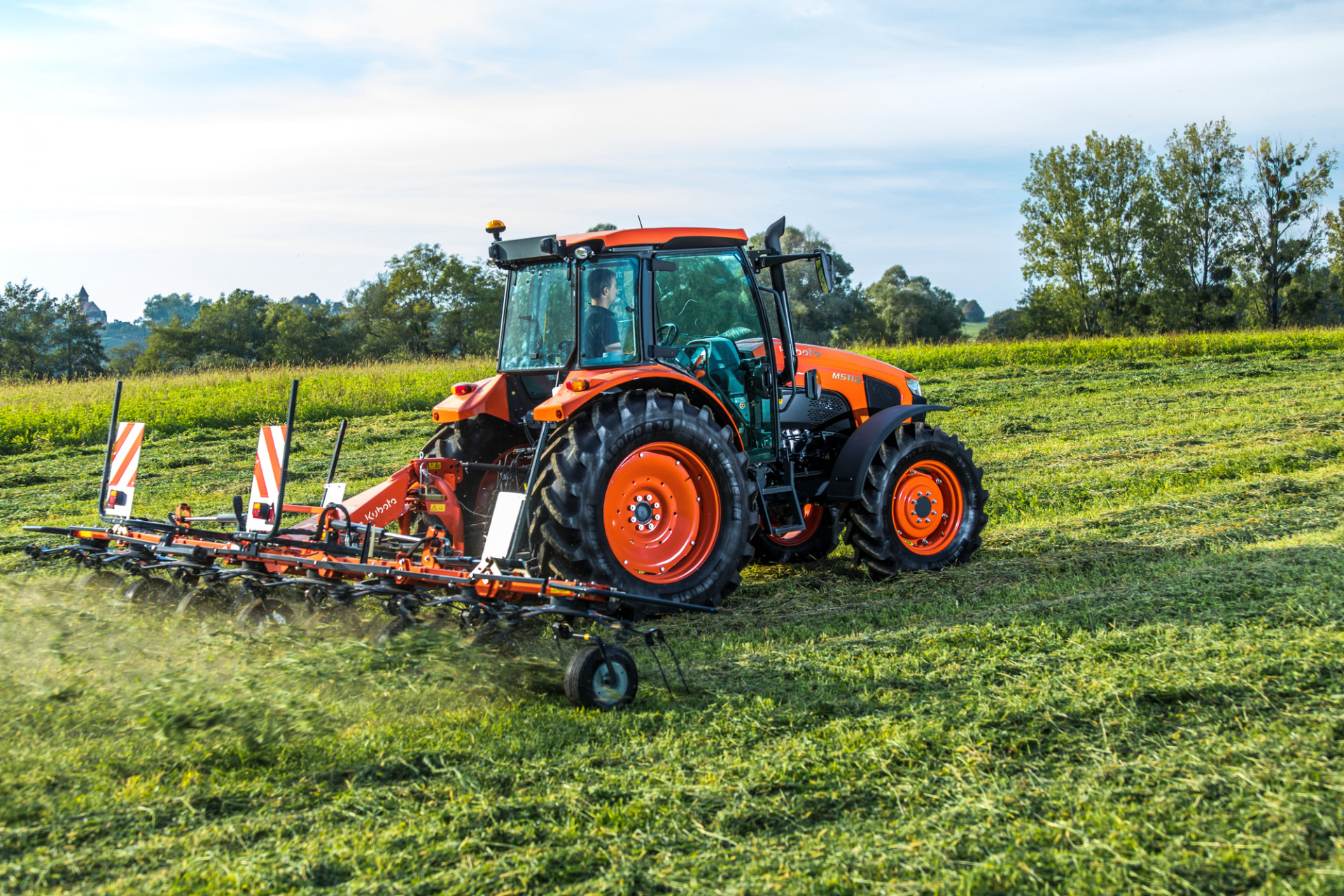
The M5-112 should suit topping, mowing, tedding, raking, bale handling and lighter baling applications where the implement is correctly matched to the tractor.
For heavier mowers, larger balers, forage wagons or more demanding transport work, the M6-131U is likely to provide the stronger platform.
Implement weight can be just as important as power. A mower or baler may appear suitable from its horsepower requirement but still place substantial demands on the tractor’s linkage, hydraulics, tyres and ballast.
Which tractor is better for fieldwork?
M5-112 for lighter field duties
The M5-112 can carry out useful field operations including:
- fertiliser spreading;
- spraying;
- topping;
- mowing;
- operating smaller drills;
- light cultivation;
- trailer work.
Kubota also offers retrofit ISOBUS terminals and precision-farming equipment for the M5002 range.
M6-131U for heavier implements
Where the tractor will regularly operate heavier mounted equipment, the M6-131U is likely to be the better fit.
The stronger Category III rear linkage, greater hydraulic flow and heavier chassis give it more scope for demanding field operations. Retrofit ISOBUS terminals, GEOCONTROL and precision-farming functions are also available for the M6001 Utility range.
The exact choice should be checked against the implements already owned or likely to be purchased during the tractor’s working life.
Which tractor is better for road work and haulage?
Both tractors have a published maximum speed of 40km/h, but that does not make their transport capability identical.
The M5-112 may be entirely suitable for general livestock trailers, local journeys and seasonal haulage.
The M6-131U is likely to be the better starting point where:
- trailers are larger;
- road journeys are longer;
- loads are heavier;
- haulage accounts for a substantial number of annual hours;
- the tractor needs to move between several farms or contracting customers.
Trailer weight, braking systems, tyre specification and legal requirements must all be considered alongside tractor power.
Which tractor is better for agricultural contractors?
For a contractor concentrating on lighter loader, grassland and estate work, the M5-112 may provide enough tractor without carrying unnecessary size between smaller sites.
However, the M6-131U is likely to suit a broader contracting workload.
Its larger chassis and stronger hydraulic and linkage specification provide greater flexibility for different customer implements and heavier jobs. It may also be easier to justify where the tractor will accumulate high annual hours across loader, field and transport work.
The decision should be based on the work that regularly generates revenue rather than the most demanding job the tractor might encounter once or twice a year.
What does the extra 18hp actually give you?
The published power difference is 18hp, but that number tells only part of the story.
Moving from the M5-112 to the M6-131U also means moving from:
- a 3.8-litre engine to a 6.1-litre engine;
- a Category II linkage to Category III;
- 4,100kg to 6,100kg of published rear lift capacity;
- 64 to 77 litres per minute of hydraulic flow;
- a 3,500kg unballasted tractor to a machine weighing approximately 4,845kg before ballast and some options.
That is a meaningful change in tractor class, not simply a small increase in engine output.
The M6-131U’s additional weight and capacity will help it suit heavier work. Conversely, the M5-112’s lower weight and smaller dimensions may be preferable in confined yards, on grassland or where the tractor’s duties do not require the larger machine.
Questions to answer before choosing either tractor
How much loader work will it do?
Estimate the percentage of annual hours likely to involve a front loader.
If loader work accounts for most of the tractor’s use, yard layout, visibility and manoeuvrability should carry significant weight in the decision.
Which implements will it operate?
Make a list of the actual implements rather than relying on a broad description such as “general fieldwork”.
Record:
- implement make and model;
- weight;
- power requirement;
- PTO speed;
- hydraulic demand;
- number of spool valves;
- linkage category;
- transport width;
- required ballast.
This information will often make the correct tractor range much clearer.
Is it a dedicated yard tractor or the farm’s main tractor?
A dedicated loader tractor and a main mixed-farm tractor may need very different specifications, even where their engine outputs appear relatively close.
The M5-112 is likely to suit the first role particularly well. The M6-131U has more scope to cover the second.
How much road work is involved?
A tractor working largely around one livestock unit has different requirements from one travelling regularly between blocks of land or contracting customers.
Consider trailer sizes, distances, road surfaces and the time operators spend travelling.
Is the existing tractor regularly at its limit?
Occasionally wishing for more power does not necessarily justify moving to a larger tractor.
Regularly struggling with implements, hydraulic demand, payloads or transport work is a stronger indication that additional capacity is required.
Will the tractor need to work inside existing buildings?
Measure the entrances and working spaces rather than estimating them.
Check:
- doorway height;
- entrance width;
- internal turning area;
- feed passages;
- roof obstructions;
- space required with the loader raised;
- clearance with the intended tyres.
A farm demonstration is the safest way to establish whether the larger M6-131U will work comfortably in the available space.
A Pecks view: decide whether the tractor lives in the yard or the field
“The first thing we look at is whether the tractor will spend more of its time in the yard or out in the field. The M5-112 is a handy size for loader work, feeding and day-to-day livestock jobs. The M6-131U gives you a bigger chassis, stronger rear linkage and more hydraulic capacity, so it suits farms asking the tractor to do more road work or carry heavier implements. A demonstration usually settles the decision because the customer can quickly feel the difference in size and capability.”
[Employee name], [job title], G & J Peck Ltd
This is a proposed employee quotation. It should be checked and approved by the named Pecks employee before publication or attribution.
Why an on-farm demonstration matters
The specification table establishes the broad differences between the tractors. A demonstration shows whether those differences matter on the individual farm.
During a demonstration, assess:
- access into the yard and buildings;
- visibility around livestock and people;
- loader controls;
- forward and reverse operation;
- turning space;
- cab access;
- attachment compatibility;
- performance with a feeder wagon or trailer;
- operation with a key mounted implement;
- road behaviour;
- operator comfort;
- access to daily service points.
Where possible, use the tractor for genuine work rather than limiting the demonstration to a short drive around the yard.
It is also worth involving every regular operator. The person buying the tractor may not be the person spending the most hours in it.
Kubota tractor dealer support across East Anglia
G & J Peck Ltd was appointed as a Kubota agricultural dealer from 1 December 2025, providing coverage across Cambridgeshire, Norfolk, Suffolk and South Lincolnshire.
The appointment includes sales, service and aftercare for Kubota’s agricultural range, supported through Pecks’ depots at Chatteris, Dereham and Rendlesham.
Kubota M5-112 and M6-131U support in Cambridgeshire
Customers looking for a Kubota M5-112 or M6-131U for sale in Cambridgeshire can contact Pecks’ Chatteris head office.
The site provides agricultural sales, service and parts support, with workshop facilities and out-of-hours arrangements. It also supports Pecks customers in South Lincolnshire.
Pecks Chatteris
Iretons Way
Chatteris
Cambridgeshire
PE16 6UZ
Telephone: 01354 699505
[CONTACT PECKS CHATTERIS]
Kubota tractors in Norfolk
Pecks’ Dereham depot supports farmers and contractors across Norfolk with agricultural machinery sales, servicing and parts.
Customers comparing the M5-112 and M6-131U can contact the local team to discuss machinery availability and arrange a demonstration.
Pecks Dereham
Yaxham Road Industrial Estate
Greens Road
Dereham
Norfolk
NR20 3TG
Telephone: 01362 698698
[CONTACT PECKS DEREHAM]
Kubota tractors in Suffolk
Pecks’ Rendlesham depot provides agricultural sales, service and parts support for customers across Suffolk.
Farmers looking for a Kubota loader tractor, mixed-farm tractor or on-farm demonstration can speak to the Rendlesham sales team.
Pecks Rendlesham
Bentwaters Parks
Rendlesham
Woodbridge
Suffolk
IP12 2TW
Telephone: 01728 441400
[CONTACT PECKS RENDLESHAM]
Kubota servicing, parts and aftersales support
The tractor’s suitability is only one part of the buying decision.
Pecks operates dedicated service centres and a mobile engineering fleet for repairs and servicing carried out on farms. The company also supplies genuine Kubota parts, with online ordering, click and collect and delivery options available.
Before ordering, it is worth discussing:
- likely annual hours;
- planned service intervals;
- warranty options;
- seasonal support;
- expected parts requirements;
- tyre and ballast specification;
- loader servicing;
- future replacement plans.
This helps ensure that the ownership and aftersales arrangement matches how intensively the tractor will be used.
Which Kubota tractor is right for your farm?
Choose the Kubota M5-112 if:
- loader and yard work make up most of the workload;
- the tractor regularly works around livestock buildings;
- feeding, bedding and bale handling are key jobs;
- it will operate lighter and medium-sized implements;
- it is being bought as a second or support tractor;
- lower weight and smaller dimensions are useful;
- general livestock and grassland duties are the priority.
Consider the Kubota M6-131U if:
- one tractor needs to cover yard, field and transport work;
- larger implements are regularly used;
- Category III linkage is required;
- hydraulic demand exceeds what the smaller tractor can comfortably provide;
- trailer and haulage work account for significant hours;
- it will act as a main tractor on a mixed or livestock farm;
- the existing tractor regularly operates close to its limits.
For many livestock farms, the M5-112 will be the more convenient everyday machine.
For a larger mixed or dairy farm expecting one tractor to perform a much broader range of work, the M6-131U is likely to provide more room for future requirements.
Arrange a Kubota M5-112 or M6-131U demonstration
Pecks supplies and supports Kubota agricultural tractors across Cambridgeshire, Norfolk, Suffolk and South Lincolnshire.
The business lists Kubota tractors through its new and used machinery section, while the local sales team can discuss model availability, specifications and demonstrations.
Speak to Pecks about your current tractor, loader, implements and workload, or arrange an on-farm demonstration of the Kubota M5-112 or M6-131U.
Frequently Asked Questions
Which is better, the Kubota M5-112 or M6-131U?
.The M5-112 is likely to be better for farms prioritising loader work, livestock duties, confined yards and lighter field operations.
The M6-131U is likely to be the better choice where heavier implements, larger trailers, regular haulage and broader fieldwork account for more of the tractor’s hours.
Neither is universally better. They suit different workloads.
What is the horsepower difference between the M5-112 and M6-131U?
Kubota publishes the M5-112 at 115hp and the M6-131U at 133hp, giving a difference of 18hp.
However, the M6-131U also has a larger engine, stronger rear linkage, higher hydraulic output and heavier chassis.
Is the Kubota M5-112 suitable for loader work?
Yes. Loader work is one of the M5-112’s strongest applications.
Kubota offers matched front-loader equipment, an electro-hydraulic shuttle and a cab designed to provide visibility around the machine. The final loader specification should be matched to the materials, attachments and lift requirements involved.
Is the Kubota M6-131U suitable for loader work?
Yes. The M6-131U can be fitted with matched Kubota loader equipment and includes features such as an electro-hydraulic reverser and roof window.
Its larger chassis may suit heavier loading, although buyers should check that its overall size remains suitable for their buildings and yard.
Which tractor is best for a dairy farm?
For daily feeding, loader, bedding, bale and yard work, the M5-112 is likely to be the most convenient starting point.
The M6-131U may be more suitable where the same tractor must also operate larger forage, slurry, field and transport equipment.
Which tractor is best for a mixed farm?
The M6-131U is likely to be the stronger all-round choice where one tractor must cover livestock work, field operations and haulage.
The M5-112 may be more appropriate as a loader, yard or support tractor alongside a larger main tractor.
What is the rear lift capacity of the Kubota M5-112?
Kubota publishes a rear linkage lift capacity of 4,100kg for the M5002 range.
It uses a Category II three-point linkage.
What is the rear lift capacity of the Kubota M6-131U?
Kubota publishes a rear linkage lift capacity of 6,100kg for the M6-131U and the other larger M6001 Utility models.
The M6-131U uses a Category III rear linkage.
Which tractor has the greater hydraulic output?
Kubota publishes hydraulic pump outputs of 64 litres per minute for the M5-112 and 77 litres per minute for the M6-131U.
The M6-131U therefore offers more hydraulic capacity for equipment and loader operations with greater flow requirements.
Can the M5-112 and M6-131U use ISOBUS implements?
Kubota offers retrofit ISOBUS equipment for both the M5002 and M6001 Utility ranges.
The final terminal, wiring and software requirements should be checked against the specific implement being used.
Where can I buy a Kubota M5-112 in Cambridgeshire?
Pecks is an authorised Kubota agricultural dealer covering Cambridgeshire and South Lincolnshire from its Chatteris head office.
Contact Pecks Chatteris on 01354 699505 to discuss machinery availability and demonstrations.
Where can I buy a Kubota M6-131U in Norfolk?
Pecks’ Dereham depot provides Kubota agricultural machinery sales, parts and service support for customers in Norfolk.
Contact Pecks Dereham on 01362 698698 to discuss tractor availability and arrange a demonstration.
Where can I buy Kubota tractors in Suffolk?
Pecks’ Rendlesham depot supports agricultural customers across Suffolk with sales, servicing and parts.
Contact Pecks Rendlesham on 01728 441400 to discuss Kubota M-series tractors.
Can Pecks arrange an on-farm Kubota tractor demonstration?
Customers considering a Kubota tractor can speak to their local Pecks sales team about demonstration availability.
Testing the tractor on the farm allows the buyer to assess access, visibility, loader performance and compatibility with existing equipment.
Does Pecks service Kubota tractors?
Yes. Pecks provides agricultural machinery servicing and repairs through dedicated service centres and mobile engineers equipped to work on farms.
Can I buy genuine Kubota tractor parts from Pecks?
Yes. Pecks supplies genuine Kubota parts through its depot network and online ordering service.
Parts can be searched by serial or part number, with click and collect and delivery options available.