JCB 542-70 vs JCB 560-80 Agri: Which Is Right for Your Farm?
If you are comparing the JCB 542-70 Agri and JCB 560-80 Agri, the main question is not simply which telehandler is bigger. It is how much of your working day involves general farm handling and how much involves high-volume bulk loading.
For many mixed, dairy, livestock and arable farms, the JCB 542-70 Agri is likely to be the more versatile everyday choice. The JCB 560-80 Agri moves the emphasis towards higher-capacity work, particularly where grain, silage, feedstock, straw or other bulk material needs to be moved in significant quantities.
Pecks is an authorised JCB Agriculture dealer providing machinery sales, demonstrations, parts, servicing and aftersales support across Cambridgeshire, Norfolk, Suffolk and South Lincolnshire.
JCB 542-70 or 560-80: the short answer
| If your priority is… | Machine to consider first |
|---|---|
| One telehandler for a wide range of everyday farm jobs | JCB 542-70 Agri |
| Dairy, livestock or mixed farming | JCB 542-70 Agri |
| Grain, fertiliser, pallets and general arable handling | JCB 542-70 Agri |
| Manoeuvrability around yards and buildings | JCB 542-70 Agri |
| High-volume bulk material handling | JCB 560-80 Agri |
| Large grain stores and intensive trailer loading | JCB 560-80 Agri |
| AD and biogas feedstock handling | JCB 560-80 Agri |
| Large-scale straw and biomass handling | JCB 560-80 Agri |
For most farms looking for one telehandler to cover a broad range of jobs, the JCB 542-70 Agri is the logical starting point. The 560-80 Agri is more relevant where higher-capacity bulk loading forms a substantial part of the machine’s workload.
JCB itself describes the 560-80 as the bulk loading and re-handling specialist in its agricultural Loadall range.
Not sure which machine suits your farm?
The difference is much easier to assess when the machines are considered against your own workload, buildings, attachments and trailers.
Speak to your local Pecks JCB team or arrange an on-farm demonstration of the machine you are considering.
JCB 542-70 Agri overview
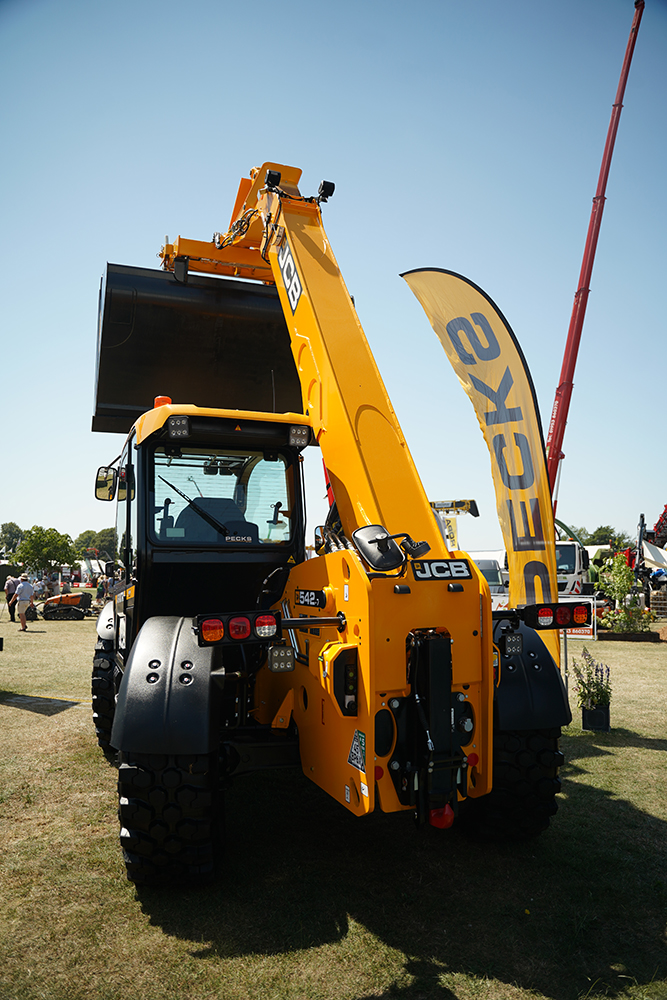
The JCB 542-70 Agri sits firmly in the all-round agricultural telehandler category.
It is the type of machine that can start the morning loading a feeder wagon, move on to bedding or muck handling, unload a delivery, shift fertiliser or seed and finish the day moving bales.
That breadth of work is what makes the 542-70 relevant to such a wide range of farms.
JCB’s current 542-70 range includes different equipment and transmission specifications, so buyers should compare the exact machine being offered rather than assuming that every 542-70 has an identical specification. Current machines feature JCB’s CommandPlus cab and Smart Hydraulics functions designed around agricultural loading work.
Who is the JCB 542-70 Agri best for?
The strongest applications include:
- dairy farms;
- beef and livestock farms;
- mixed farms;
- arable farms;
- agricultural contractors;
- straw and hay businesses;
- larger poultry and pig units;
- estates and equestrian operations requiring a substantial all-round handler.
The common requirement is versatility.
Rather than purchasing a telehandler predominantly for one heavy-loading application, these businesses need a machine that may perform several different tasks in the same working day.
JCB 560-80 Agri overview
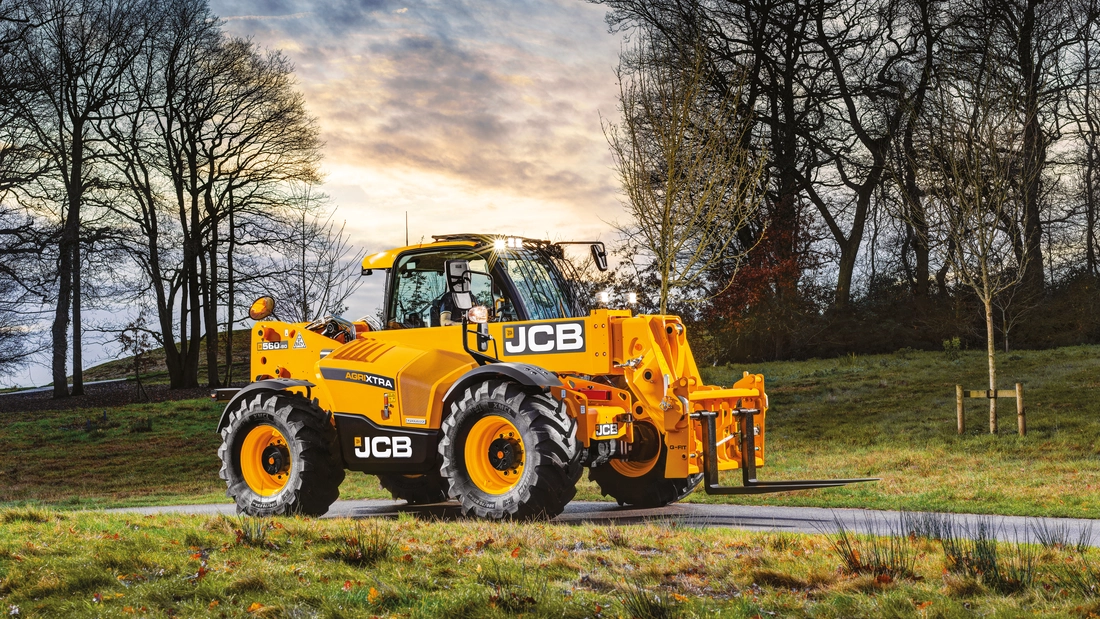
The JCB 560-80 Agri serves a different type of workload.
JCB describes the 560-80 as the highest-capacity agricultural Loadall in its range, with a quoted maximum lift capacity of 6,000kg. It has also specifically positioned the machine as a bulk loading and re-handling specialist.
That makes it particularly relevant where moving material is not simply another farm task but one of the telehandler’s main jobs.
Typical examples include:
- loading large quantities of grain;
- handling clamp silage;
- moving AD feedstock;
- loading and stacking high volumes of straw;
- handling biomass;
- moving muck or compost;
- agricultural contracting involving substantial loading work.
The question for a buyer is therefore whether that additional capacity will be used regularly enough to justify moving to a larger machine.
JCB 542-70 vs 560-80 Agri comparison
| JCB 542-70 Agri | JCB 560-80 Agri | |
|---|---|---|
| Primary role | Versatile everyday agricultural Loadall | High-capacity bulk handling and re-handling |
| Strongest fit | Mixed farm duties | Intensive material handling |
| Typical buyers | Dairy, livestock, mixed and arable farms | Large arable units, AD plants, straw businesses and contractors |
| Common jobs | Feed, bales, muck, silage, grain, fertiliser and pallets | Grain, silage, feedstock, muck, straw and bulk materials |
| Maximum lift capacity | Depends on exact 542-70 version being considered | JCB quotes up to 6,000kg |
| Main buyer priority | Versatility and everyday usability | Capacity and bulk-loading output |
| Best starting point if unsure | Yes, for a broad mixed workload | Where high-capacity work is already clearly required |
This distinction matters.
A farm should not necessarily buy the biggest handler it can justify on paper. Equally, an operation repeatedly working close to the limits of its existing machine may be losing time by running a handler that is too small for the job.
The right choice comes from understanding where the machine will spend most of its hours.
Which is better for dairy farms?
For most dairy farms: JCB 542-70 Agri
A dairy telehandler rarely has a single job.
Feeding, clamp work, bedding, bales, muck, unloading deliveries and general yard duties can result in numerous short operating cycles throughout the day.
That type of varied workload makes the 542-70 Agri a strong starting point for many medium-to-large dairy farms.
Manoeuvrability and suitability for everyday yard work can be just as important as outright capacity, particularly where the machine needs to work around livestock buildings and confined areas.
When should a dairy farm consider the 560-80?
Larger dairy operations handling substantial volumes of clamp silage, feed or muck should also consider the 560-80.
The useful question is:
Is your existing telehandler regularly reaching its limits, or do you only need additional capacity occasionally?
If it is regularly reaching those limits, moving towards a larger bulk-handling machine can make considerably more sense.
Which is better for mixed farms?
Best fit: JCB 542-70 Agri
Mixed farms are arguably one of the clearest applications for the 542-70.
The machine might be handling livestock feed in the morning and grain or fertiliser later in the week. Bale work, pallets, muck and general loading can all fall to the same handler.
When one machine is expected to cover several enterprises, having the right all-rounder is usually more valuable than choosing around the most demanding job it might encounter once or twice a year.
Which is better for arable farms?
The answer depends heavily on the scale of the grain operation.
General arable farm: JCB 542-70 Agri
Where the handler is expected to move between:
- grain;
- fertiliser;
- seed;
- pallets;
- attachments;
- general yard work;
- seasonal bale handling;
the 542-70 is likely to be the first machine worth assessing.
Large grain store: JCB 560-80 Agri
For businesses where the telehandler spends significant periods loading grain and high-sided trailers, the 560-80 becomes much more relevant.
JCB’s own positioning of the 560-80 as a bulk loading and re-handling specialist reflects this type of application.
Across the arable areas of Cambridgeshire, Norfolk, Suffolk and South Lincolnshire, this workload distinction is particularly important. Two businesses may farm a similar acreage but have very different telehandler requirements depending on how grain is stored, handled and transported.
Which is better for straw and bale handling?
Both machines have a place in bale work.
For a mixed or livestock farm handling its own straw, the broader versatility of the 542-70 may make it the more appropriate machine.
The calculation changes for a straw merchant, biomass operation or contractor moving large numbers of bales.
Where bale handling and loading accounts for a significant proportion of annual telehandler hours, the additional capabilities of the 560-80 may be easier to justify.
Which is better for agricultural contractors?
It depends on what earns the machine its money.
A contractor working across several farms and carrying out a mixture of bale handling, muck, silage and general loading needs a telehandler capable of adapting to different sites and jobs.
That points towards the 542-70.
A contractor specialising in bulk materials, high-volume loading or working on larger sites may place a much higher value on the capabilities of the 560-80.
Buying around the machine’s main revenue-earning workload is normally more useful than buying around the toughest individual job it might encounter.
Which is better for an AD or biogas plant?
Best fit: JCB 560-80 Agri
AD and biogas plants are among the clearer applications for the 560-80.
Moving maize, silage and other feedstocks can put substantial hours onto a loading machine, and repetitive bulk handling makes productivity and capacity particularly important.
A similar argument applies to suitable composting, biomass and bulk-material operations.
When repeated loading forms the core workload rather than an occasional task, the case for the larger machine becomes considerably stronger.
The questions to ask before choosing either machine
Rather than beginning with “which telehandler is bigger?”, it is worth looking at how the machine will actually be used.
1. What percentage of its hours will involve bucket work?
If repetitive bucket loading makes up most of the machine’s day, capacity and loading output become increasingly important.
2. How much bale handling will it do?
Handling several hundred bales over a season is a different requirement from running a commercial straw operation.
3. What trailers are being loaded?
Trailer height, loading position and yard layout should be considered alongside maximum capacity.
4. How confined is the yard?
A machine that spends most of its life around livestock buildings has different requirements from one working in a large grain store or open clamp.
5. Which attachments are already used?
Buckets, bale grabs, pallet forks, muck forks and other attachments all need to form part of the discussion.
JCB offers agricultural attachments including grain shovels across its Loadall range.
6. Is the existing machine regularly working at its limits?
This is one of the most useful questions.
Occasionally needing more capacity does not necessarily mean the business needs a larger handler.
Regularly reaching the limit is a different matter.
7. How much road work is involved?
Contractors and farms split across several sites should consider travelling requirements alongside loading performance.
8. Who will operate the machine?
If several employees use the handler every day, visibility, controls, access and operator comfort should be assessed by more than one person during a demonstration.
A Pecks view: what should buyers look at first?
“When someone is choosing between a 542-70 and a 560-80, the first thing I want to understand is what the machine will actually spend most of its time doing. There’s little point choosing purely on maximum capacity if most of its hours are feeding, handling bales or doing general yard work. The 542-70 is a very capable all-round machine for that sort of mixed workload. Where customers are regularly shifting large volumes of grain, silage, straw or other bulk material, that’s when we start looking more closely at the 560-80. The best way to make that decision is to put the machine to work on the farm and see how it fits the operation.”
Why an on-farm demonstration matters
A specification sheet cannot show how a telehandler will feel inside your own buildings.
An on-farm demonstration allows the operator to assess:
- manoeuvrability in the actual yard;
- visibility when approaching trailers or stacks;
- controls and operator environment;
- attachment compatibility;
- loading cycles;
- access into livestock buildings or stores;
- performance with the materials the farm actually handles.
It can also establish very quickly whether moving from a 542-70 to a 560-80 would make a meaningful difference to the operation.
If several people regularly operate the telehandler, it is worth having them all try the machine during the demonstration rather than relying on one person’s assessment.
JCB telehandler dealer support across East Anglia
Choosing the machine is only part of the buying decision.
Telehandlers often accumulate substantial hours and can be central to feeding, harvest, loading and general farm operations. Access to parts, servicing and technical support therefore matters throughout the ownership period.
G & J Peck Ltd is an authorised JCB Agriculture dealer covering Cambridgeshire, South Lincolnshire, Norfolk and Suffolk, with local sales, parts and service support available through its depot network.
JCB sales and support in Cambridgeshire and South Lincolnshire
Pecks’ Chatteris head office in Cambridgeshire has dedicated agricultural machinery sales, parts and service teams and supports customers throughout the surrounding territory.
Customers looking for a JCB 542-70 Agri or JCB 560-80 Agri for sale in Cambridgeshire or South Lincolnshire can contact the Chatteris team to discuss machinery, demonstrations and ongoing support.
Pecks Chatteris Depot
- Iretons Way, Chatteris, Cambridgeshire, PE16 6UZ
- Telephone: 01354 699505
JCB sales and support in Norfolk
Pecks’ Dereham depot provides local agricultural machinery sales, servicing and parts support for customers across Norfolk. The depot has dedicated sales and territory service personnel.
Farmers and contractors looking for a JCB telehandler dealer in Norfolk, a new JCB Loadall or an on-farm demonstration can contact the Dereham team.
Pecks Dereham Depot
- Yaxham Road Industrial Estate, Dereham, Norfolk, NR20 3TG
- Telephone: 01362 698698
JCB sales and support in Suffolk
Pecks’ Rendlesham depot near Woodbridge provides machinery sales, parts and servicing support for Suffolk customers.
Customers comparing a JCB 542-70 or JCB 560-80 in Suffolk can speak to the Rendlesham sales team about new machinery and demonstrations.
Pecks Rendlesham Depot
- Bentwaters Parks, Rendlesham, Woodbridge, Suffolk, IP12 2TW
- Telephone: 01728 441400
JCB sales, parts, servicing and aftersales support
The relationship with the dealer continues after delivery.
Pecks provides JCB machinery sales, genuine parts, servicing and aftersales support as part of its agricultural dealership operation. The business has been working with agricultural machinery since the 19th century and currently represents JCB alongside a number of other agricultural manufacturers.
For a telehandler working every day during feeding or at full pace through harvest, the availability of parts and service support is a practical consideration when choosing both the machine and dealer.
Which JCB telehandler is right for your farm?
For most businesses, the decision can be simplified to this:
Choose the JCB 542-70 Agri if:
- you need one telehandler for a broad mixture of jobs;
- dairy, livestock or mixed farming forms a significant part of the workload;
- the machine frequently works around yards and buildings;
- grain, fertiliser, pallets and bales are all part of its working year;
- versatility is more important than maximum bulk-loading capacity.
Consider the JCB 560-80 Agri if:
- bulk handling is one of the machine’s main jobs;
- you operate a large grain store;
- high-volume trailer loading is routine;
- you run an AD or biogas operation;
- substantial quantities of silage, feedstock, straw or other material are being moved;
- your existing handler regularly reaches its working limits.
The correct answer will still depend on the individual farm.
That is why comparing the machines on the site where they will actually work is more useful than making the decision purely from a brochure.
Arrange a JCB 542-70 or 560-80 demonstration in East Anglia
If you are considering a new JCB 542-70 Agri or JCB 560-80 Agri for sale in Cambridgeshire, Norfolk, Suffolk or South Lincolnshire, speak to your local Pecks JCB team.
Pecks can discuss your current machinery, workload, attachments and future requirements and arrange a demonstration so you can assess the machine in a real working environment.
Frequently Asked Questions:
For a broad mixture of everyday farm work, the JCB 542-70 Agri is likely to be the better starting point.
For businesses where high-capacity bulk loading is a major part of the workload, the JCB 560-80 Agri is more likely to suit the operation.
JCB positions the 560-80 specifically as a bulk loading and re-handling specialist.
The JCB 542-70 Agri is suited to a broad range of agricultural handling jobs including feed, silage, bales, muck, grain, fertiliser, pallets and general yard work.
It is particularly relevant to dairy, livestock, mixed and arable farms that need one telehandler to perform several different jobs.
The 560-80 Agri is best suited to higher-volume material handling.
Typical users include large arable farms and grain stores, AD plants, large dairy units, straw and biomass businesses and contractors carrying out substantial loading work.
JCB quotes a maximum lift capacity of 6,000kg for the 560-80 Agri. Actual permitted loads depend on boom position, attachment and operating conditions, so the appropriate machine load chart must always be followed.
Not necessarily.
The better question is how frequently that extra capacity will actually be used.
If your current machine regularly operates close to its limits, moving to a larger handler may be justified. If the additional capacity would only be needed occasionally, an all-round machine better suited to the majority of the workload may make more sense.
Pecks offers machinery demonstrations for customers considering new agricultural equipment.
An on-farm demonstration allows you to assess the telehandler with your own buildings, trailers, materials and working conditions rather than relying entirely on published specifications.
Contact your local Pecks sales team to discuss demonstration availability.
Pecks is an authorised JCB Agriculture dealer with its head office and agricultural machinery sales operation at Chatteris in Cambridgeshire.
Contact the Chatteris team on 01354 699505 to discuss JCB telehandlers, current machinery availability and demonstrations.
Pecks’ Dereham depot provides agricultural machinery sales, parts and servicing support for customers across Norfolk.
Contact Pecks Dereham on 01362 698698 to discuss JCB Loadalls and demonstration availability.
Pecks’ Rendlesham depot supports agricultural machinery customers in Suffolk with sales, servicing and parts.
Contact Pecks Rendlesham on 01728 441400 to discuss JCB telehandlers and arranging a demonstration.
Yes. Pecks provides agricultural machinery servicing and aftersales support through its depot network, with dedicated service teams at Chatteris, Dereham and Rendlesham.
Pecks is an authorised JCB Agriculture dealer and provides genuine parts alongside machinery sales and service support.
Customers can contact the parts department at their local Pecks depot.
For Cambridgeshire and South Lincolnshire, start with Pecks Chatteris.
For Norfolk, contact Pecks Dereham.
For Suffolk, contact Pecks Rendlesham.
If you are unsure which sales territory your farm falls into, contact Pecks and the enquiry can be directed to the appropriate member of the team.