
Best Mower for 1 to 5 Acres: Ride-On, Zero-Turn or Compact Tractor?
Choosing a mower for one to five acres is not simply a matter of finding the widest cutting deck available.
A formal lawn around a country house has different requirements from hotel grounds, a paddock, a school site or an estate containing trees, paths and outbuildings. The total area matters, but so do the finish required, the number of obstacles, whether clippings need to be collected and whether the machine will be used for other jobs.
One acre is approximately 4,047 square metres. Five acres is more than 20,000 square metres, so choosing the wrong mower can add a considerable amount of unnecessary time to every cut.
This guide compares ride-on, zero-turn, front, robotic and compact tractor mowers for landowners, estates, hotels, schools and professional grounds teams across Cambridgeshire, Norfolk, Suffolk, South Lincolnshire and the wider East Anglia region.
What is the best mower for one to five acres?
For around one acre of formal lawn, a ride-on cut-and-collect mower is usually the most practical starting point. A suitably specified robotic mower may also work where the lawn is regularly maintained and the layout is suitable.
For one to three acres containing trees, beds or other obstacles, a zero-turn or front mower can reduce manoeuvring time and make it easier to cut close to obstructions.
For three to five acres, a commercial zero-turn mower, professional front mower or compact tractor with a suitable mowing deck is normally more appropriate than a smaller domestic lawn tractor.
A compact tractor makes the strongest case when the machine also needs to operate a loader, trailer, flail, aerator, spreader or other estate equipment.
| Main requirement | Machine to consider first |
|---|---|
| Formal lawn with grass collection | Ride-on cut-and-collect mower |
| Open grass with numerous trees or obstacles | Zero-turn mower |
| Access beneath benches, shrubs and low branches | Front mower |
| Three to five acres with additional estate work | Compact tractor and mower |
| Regular unattended cutting on suitable lawns | Robotic mower |
| Golf greens, tees or fine sports turf | Specialist cylinder mower |
| Longer grass, rough areas or paddock margins | Compact tractor with suitable rotary or flail mower |
These are starting points rather than fixed rules. Two properties of the same acreage can require completely different machines.
Mower types compared
| Mower type | Strongest applications | Main advantages | Points to consider |
|---|---|---|---|
| Ride-on cut-and-collect | Formal lawns, hotels, large homes and presentation areas | Familiar controls, tidy finish and clippings removed | Collector emptying and disposal add time |
| Zero-turn mower | Open grounds with trees, posts, beds and obstacles | Fast manoeuvring and efficient trimming around obstacles | Collection may not be standard; slope suitability needs checking |
| Front mower | Hotels, estates, parks and complex landscaped grounds | Clear view of deck and access beneath obstructions | Usually a greater investment than a domestic ride-on |
| Compact tractor and mower | Estates, equestrian sites, grounds teams and multi-purpose work | Can mow and operate many other attachments | Larger, heavier and not always as quick around small obstacles |
| Robotic mower | Regularly maintained lawns where daily labour needs reducing | Frequent cutting, low daily operator input and mulching | Site layout, installation, security and separate zones matter |
| Cylinder mower | Golf courses and high-quality sports surfaces | Fine, consistent finish at low cutting heights | Specialist machine requiring appropriate adjustment and maintenance |
Ride-on cut-and-collect mowers
A conventional ride-on mower remains a sensible choice for many large gardens, smaller estates and hotel lawns.
It is particularly useful where presentation matters and grass clippings cannot be left on the surface. Collection can help produce a tidy result around:
- hotels and wedding venues;
- country houses;
- public-facing gardens;
- caravan and holiday parks;
- school grounds;
- formal estate lawns;
- areas used for events.
A mower such as the STIHL RT 5097 provides an example of this type of machine. STIHL rates the RT 5097 for lawns up to 6,000 square metres, which is roughly 1.5 acres. It uses a hydrostatic transmission and has a 250-litre grass collector that can be emptied from the operator’s seat. STIHL UK
That does not mean every 1.5-acre site is automatically suited to that model. Slopes, gateways, obstacles, wet ground and mowing frequency still matter.
Where does a ride-on mower begin to struggle?
The main limitation is not always cutting width. It can be the time spent:
- driving to an unloading point;
- emptying the collector;
- dealing with grass clippings;
- reversing around trees and beds;
- passing through restricted gateways;
- cutting areas that are too wet for clean collection.
For an open formal lawn of around an acre, these limitations may be minor. Across four or five acres, repeated collector emptying can become a substantial part of the job.
Zero-turn mowers
A zero-turn mower is designed to turn within its own footprint using independently controlled drive wheels.
This can make it significantly easier to work around:
- trees;
- lamp posts;
- play equipment;
- electric hook-up points;
- signs;
- flower beds;
- fenced areas;
- individual buildings.
Kubota’s ZD1211 is a commercial diesel zero-turn mower designed for professional use. It has a three-blade commercial mower deck, hydrostatic drive and operator features intended to support longer working periods. Kubota
Kubota has also documented the ZD1211 being used on a large estate containing event spaces, a caravan park, gardens and parkland. In that application, manoeuvrability around trees and caravan hook-up points was a major part of the buying decision. Kubota
When does a zero-turn mower make sense?
A zero-turn mower is likely to suit:
- properties with large open lawns broken up by trees;
- hotels with landscaped grounds;
- caravan and holiday parks;
- schools with several grassed areas;
- cemeteries;
- contractors cutting numerous different sites;
- landowners prioritising mowing speed.
The benefit becomes greater when the operator would otherwise spend a lot of time reversing, making three-point turns or returning to trim around obstacles.
Is a zero-turn mower suitable for slopes?
That depends on the individual machine, the severity and direction of the slope, ground conditions and manufacturer guidance.
A zero-turn mower should not be selected for a sloping site based solely on how quickly it cuts level ground. The site should be assessed properly, ideally through a demonstration.
Front mowers
A front mower positions the deck ahead of the operator rather than beneath the centre of the machine.
This gives the operator a clear view of the cutting area and allows the deck to reach beneath some low branches, benches, shrubs and overhanging features.
Kubota describes its F-Series front mowers as machines designed for efficient professional mowing and mulching. The front-mounted deck allows the operator to see where they are cutting and improves access around flower beds, fences and trees. Kubota
Where is a front mower most useful?
Typical applications include:
- hotel and wedding venue grounds;
- parks and public gardens;
- hospitals and campuses;
- schools;
- landscaped estates;
- local authority sites;
- commercial grounds maintenance;
- areas containing numerous paths, beds and obstacles.
A front mower may complete a complex site more efficiently than a wider machine that cannot reach beneath obstructions or closely follow landscaped edges.
Kubota’s professional out-front range includes machines intended for demanding and high-output work. For example, the F3890 is positioned for large areas and heavy workloads, with four-wheel drive for more demanding conditions.
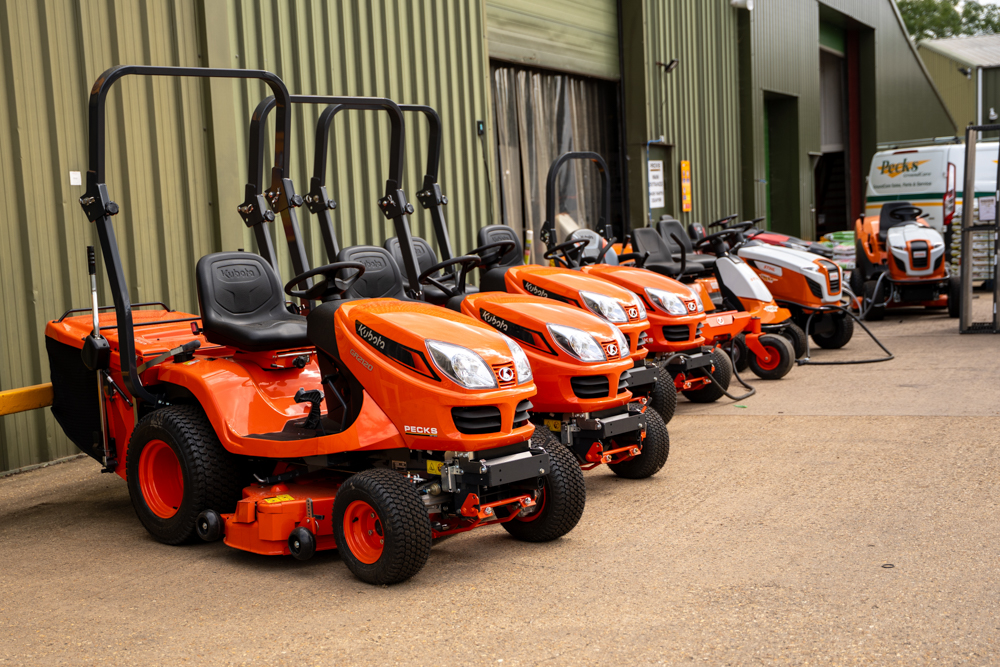
Compact tractors with mower decks
A compact tractor becomes particularly relevant when mowing is only one part of the machine’s job.
Kubota compact tractors can be equipped for mowing while also operating other equipment from front, mid and rear attachment points. The BX range, for example, can work with mowing decks, loaders and three-point linkage equipment. Kubota
A compact tractor could potentially be used for:
- mowing;
- trailer work;
- loader work;
- moving soil, mulch or gravel;
- operating a flail mower;
- sweeping;
- aerating;
- overseeding;
- spreading;
- winter maintenance;
- paddock and estate work.
When is a compact tractor better than a dedicated mower?
A compact tractor is likely to make more sense where:
- the site is closer to three or five acres than one acre;
- mowing is only one of several regular jobs;
- parts of the site contain longer or rougher grass;
- a loader or trailer is required;
- turf renovation equipment will be used;
- the property operates throughout the year;
- a dedicated ride-on would spend much of the year unused.
The disadvantage is that a compact tractor is larger and heavier than most ride-on mowers. It may also be slower around closely spaced obstacles.
A dedicated zero-turn or front mower will usually remain more efficient if the machine’s only job is cutting maintained grass.
Can a robotic mower handle a large lawn?
A robotic mower can work well on a large, regularly maintained lawn, but acreage alone does not determine whether it is suitable.
The layout needs to be assessed for:
- separate mowing zones;
- narrow passages;
- trees and beds;
- ponds and water features;
- slopes;
- public access;
- fallen leaves;
- charging-point location;
- security;
- mobile or Wi-Fi coverage, depending on the system;
- how the mower moves between different lawn areas.
Robotic mowers cut little and often, leaving fine clippings on the lawn rather than collecting them. Pecks supplies robotic mowing systems and provides advice, installation and aftersales support through its groundcare operation. Pecks Ltd
Is a robotic mower practical for five acres?
Potentially, but only where the chosen system is rated for the area and the site can be divided or managed effectively.
A complicated five-acre estate containing several disconnected lawns may need multiple machines or a different solution. A single, open and well-defined grass area presents a much simpler installation.
A robotic mower may also work alongside a ride-on or compact tractor. The robot can maintain formal lawns while the larger machine handles rougher, seasonal or more remote areas.
Specialist cylinder mowers for golf and fine turf
A general ride-on or zero-turn mower is not the right machine for every large grassed site.
Golf greens, tees, cricket squares and some high-quality sports surfaces require specialist mowing equipment capable of delivering a consistent fine cut at controlled heights.
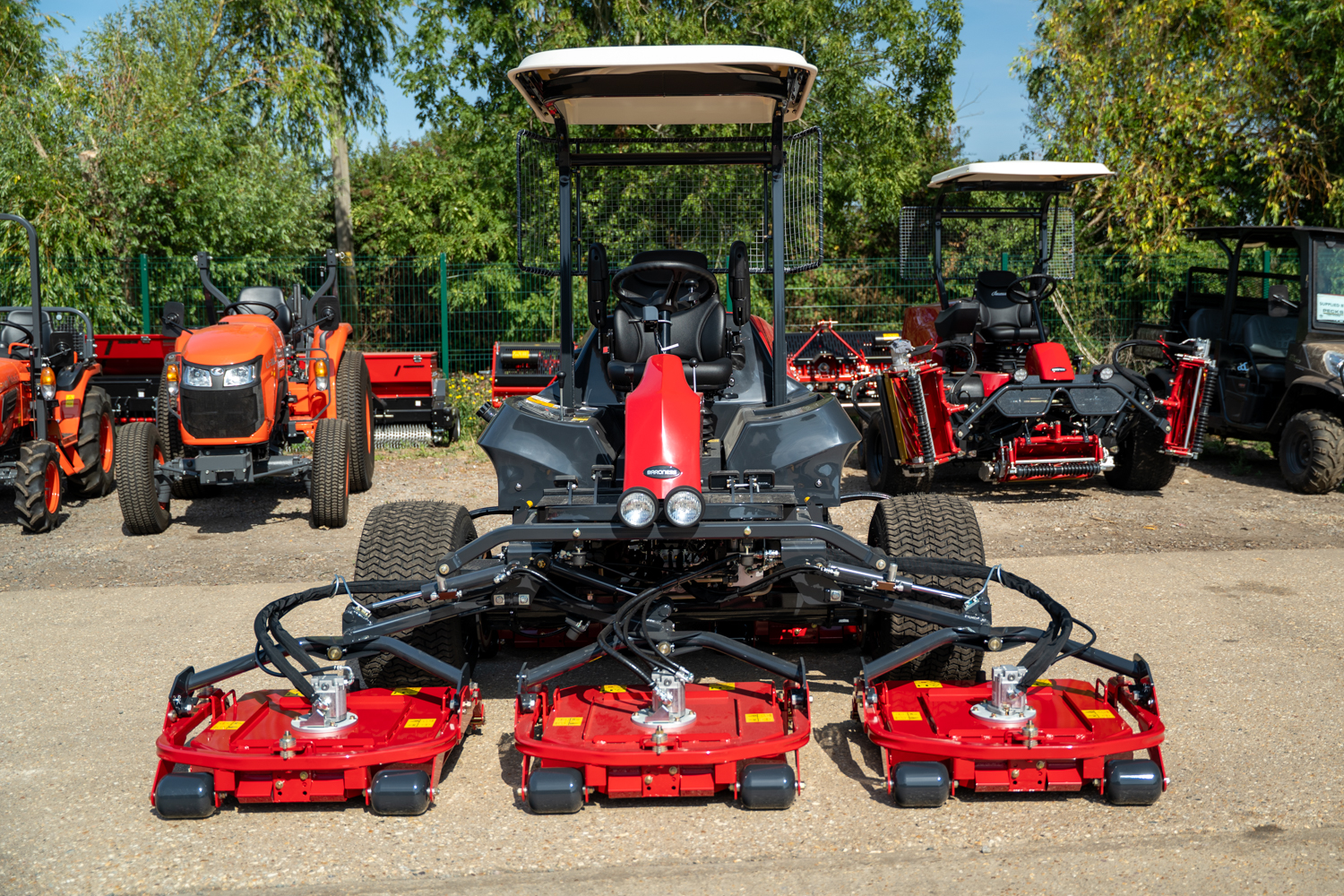
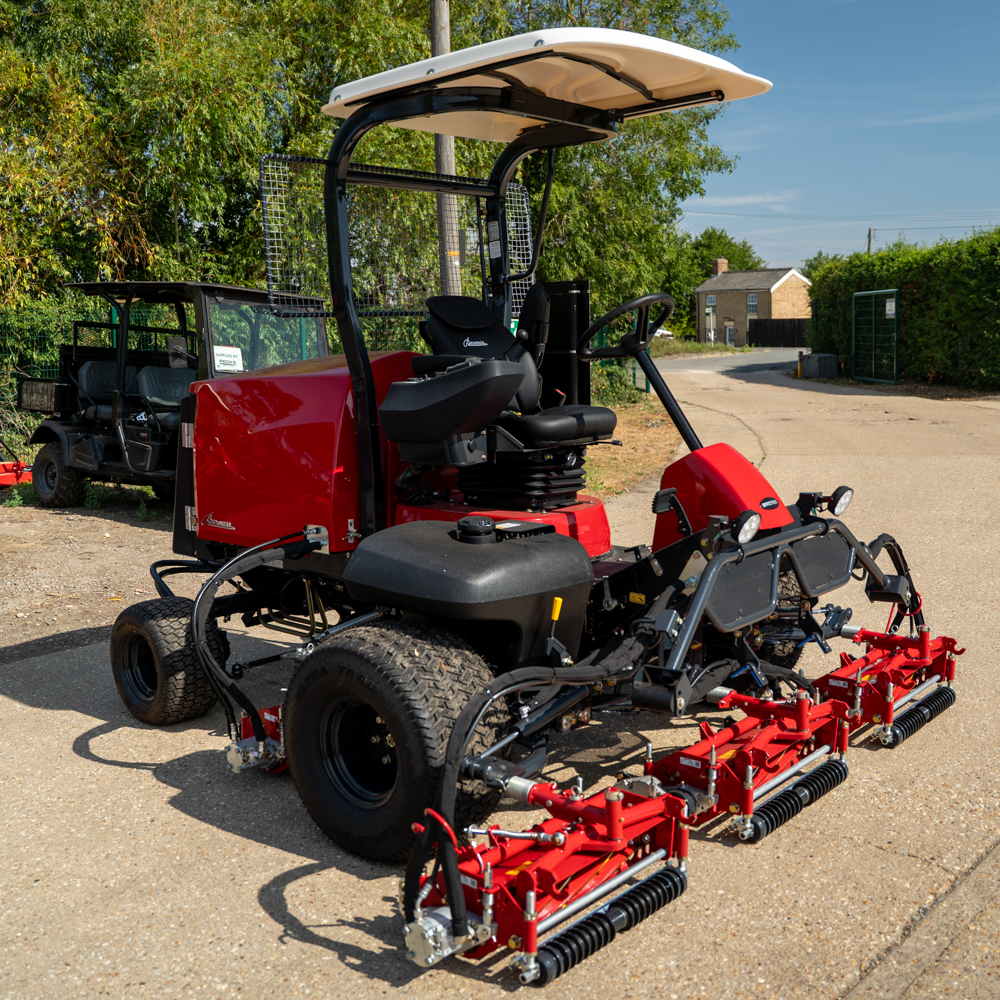
Baroness manufactures professional cylinder mowers for golf courses and sports grounds. Its range includes machines for greens, tees, approaches, surrounds, fairways, rough and sports fields. Pecks supplies Baroness equipment to golf clubs, sports facilities, local authorities and professional contractors. Pecks Ltd
For a golf course, the correct answer is unlikely to be one mower for the entire site. Greens, tees, fairways, surrounds and rough normally require different cutting units and working widths.
Which mower is suitable for different acreages?
Acreage provides a useful first filter, but the site itself should make the final decision.
Best mower for around one acre
For a formal lawn of around one acre, the strongest options are usually:
- a ride-on cut-and-collect mower;
- a smaller zero-turn mower;
- a suitable robotic mower;
- a front mower where there are many obstacles.
A STIHL ride-on can make sense where collection and a tidy presentation are priorities. A zero-turn is likely to be more useful where trees and other obstacles dominate.
A compact tractor may be unnecessary unless the owner also needs attachments for estate or paddock work.
Best mower for one to two acres
At this size, mowing time becomes more important.
A professional ride-on remains suitable where grass collection is essential. However, a zero-turn or front mower can be more productive where cuttings may be mulched or discharged and the site has numerous obstacles.
A robotic mower also becomes worth considering if the entire area is suitable for regular automated cutting.
Best mower for two to three acres
For two to three acres, buyers should begin looking beyond smaller domestic lawn tractors.
Likely options include:
- professional ride-on mower;
- commercial zero-turn mower;
- front mower;
- compact tractor with a mid-mounted or rear mower;
- more than one robotic mower or a higher-capacity system.
Expected annual hours become increasingly important. A private owner mowing every seven to ten days may have different requirements from a hotel or contractor cutting several times each week.
Best mower for three to five acres
For three to five acres, a commercial machine is normally the sensible starting point.
A zero-turn mower will suit maintained grass containing obstacles. A front mower will be useful on complex landscaped grounds. A compact tractor becomes attractive when the owner also needs to carry out loader, trailer or attachment work.
A smaller ride-on can technically cut a large area, but that does not mean it is the most efficient or durable choice for the workload.
Five acres is approximately 20,234 square metres. At that scale, downtime, mowing speed, fuel capacity, operator comfort and servicing support all become more significant.
Which mower is best for different buyers?
Large private gardens and country homes
For a formal garden of around one acre, a STIHL ride-on cut-and-collect mower may provide the most familiar and practical solution.
As the area grows or the number of trees increases, a Kubota zero-turn or front mower becomes more relevant.
A landowner with paddocks, tracks, trailers and year-round maintenance jobs should also consider whether a Kubota compact tractor would provide better overall value than a dedicated mower.
Hotels, wedding venues and holiday parks
Presentation and disruption both matter on a hospitality site.
A hotel may need to cut grass around:
- guests;
- parked vehicles;
- outdoor seating;
- wedding photographs;
- play areas;
- accommodation units;
- paths and landscaped beds.
A ride-on cut-and-collect mower can leave a tidy surface, while a front mower provides better access around landscape features.
Zero-turn mowers can be useful on caravan and holiday sites containing numerous individual obstacles. Robotic mowing may suit formal areas where low-noise, frequent cutting is preferable, provided public access and security can be managed.
Large estates and equestrian properties
An estate often needs more than a lawn mower.
Alongside formal grass, it may have:
- paddocks;
- tracks;
- woodland edges;
- verges;
- courtyards;
- trailers;
- arenas;
- rougher grass;
- leaf and debris management.
In that situation, a Kubota compact tractor with an appropriate mower and additional attachments may be more useful than a dedicated ride-on.
A separate smaller mower or robot can still be used for the formal lawn.
Schools and public grounds
Schools and public sites often contain large open areas mixed with buildings, fences, play equipment and restricted access points.
A front mower or commercial zero-turn can provide good output around obstacles. Collection requirements will depend on how the site is used and the standard of finish required.
The machine should also be assessed for operator training, storage, noise, public safety and servicing support.
Golf courses and sports facilities
Golf and professional sport require a more specialist approach.
A Baroness cylinder mower should be considered where fine turf quality is the priority. Separate rotary machines may still be needed for rough, banks, surrounds or less formal areas.
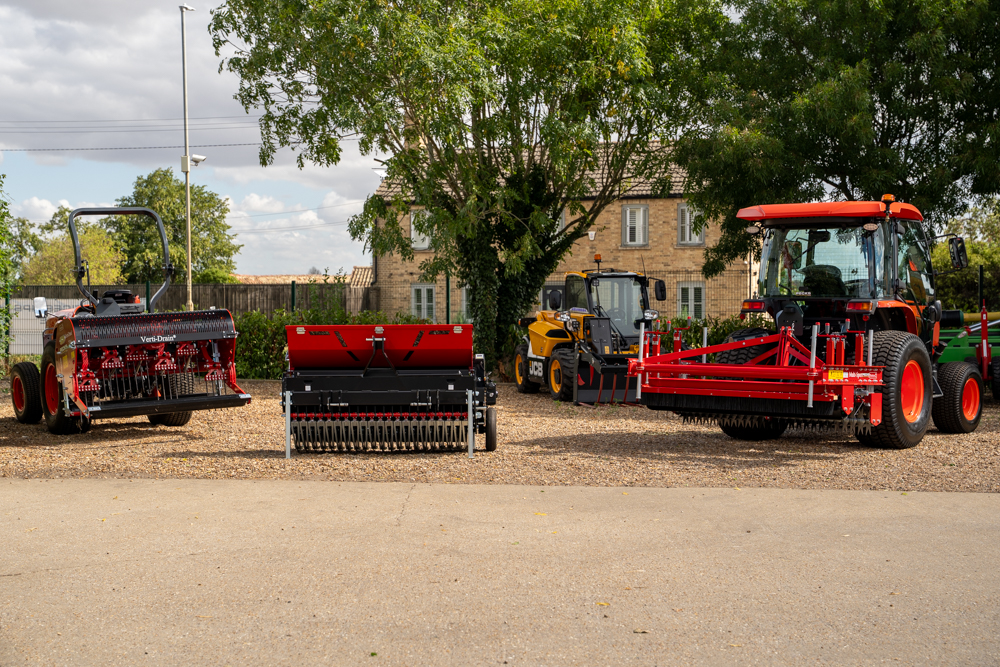
Mowing is only one part of turf management. Pecks also supplies Redexim aerators, overseeders and other professional turf-maintenance equipment for golf courses and sports grounds. Pecks Ltd
Collection, discharge or mulching?
The cutting system can be just as important as the machine carrying it.
Cut and collect
Best suited to:
- formal lawns;
- hotels and venues;
- public-facing spaces;
- areas where loose clippings would be undesirable.
The result is tidy, but the operator needs somewhere to empty and dispose of the grass.
Side or rear discharge
Best suited to:
- larger open areas;
- less formal grounds;
- frequent mowing where clippings are acceptable;
- sites prioritising productivity.
Discharge avoids collector-emptying time but may leave visible material, particularly if the grass is long or wet.
Mulching
Best suited to:
- lawns cut regularly;
- sites where fine clippings can remain;
- operators wanting to avoid collecting and disposing of grass.
Mulching performance usually depends on cutting little and often. Long, wet or heavy grass may require a different approach.
Questions to answer before buying a mower
How much grass is actually being cut?
The property may cover five acres, but buildings, woodland, water, beds and hardstanding could substantially reduce the mowing area.
Measure the maintained grass rather than relying solely on the total site size.
What finish is required?
A hotel lawn and a paddock margin do not need the same machine.
Decide whether the priority is:
- a collected formal finish;
- regular mulching;
- quick clearance of open areas;
- fine cylinder mowing;
- controlling longer grass.
How many obstacles are there?
Trees, beds, benches and posts can make manoeuvrability more important than cutting width.
A slightly narrower zero-turn or front mower may finish a complex site faster than a wider conventional lawn tractor.
Is grass collection essential?
Collection adds time and creates material that must be transported or composted.
Do not specify a collector simply because the current mower has one. Consider whether discharge or mulching would be acceptable on some or all of the site.
How wet or uneven is the ground?
Tyres, traction, mower position, overall weight and ground clearance all matter.
The best machine for a flat, free-draining formal lawn may be unsuitable for uneven estate ground.
Are there slopes?
The slope should be assessed using the manufacturer’s operating guidance for the exact mower.
A machine that is highly productive on level ground should not automatically be assumed suitable for banks or cross-slope working.
Does the machine need to do anything besides mowing?
This is often the question that separates a compact tractor from a dedicated mower.
Where loader work, trailers, aeration, overseeding or winter tasks are involved, a compact tractor may be the stronger investment.
A practical Pecks view
“When someone tells us they need a mower for three or four acres, acreage is only the starting point. Trees, gateways, slopes, grass collection and how often the site is cut usually decide whether a ride-on, zero-turn, front mower or compact tractor is the better fit. The right machine is the one that completes the whole site efficiently and still suits the other jobs the owner needs it to do.”
Why a demonstration or site assessment matters
The differences between mower types become much clearer on the site itself.
A useful demonstration should assess:
- access through gates and between buildings;
- turning around trees and landscape features;
- the required cutting finish;
- collection and unloading;
- slopes and uneven ground;
- wet or shaded areas;
- operator comfort;
- storage and transport;
- routine maintenance access;
- expected mowing time.
Where a compact tractor is being considered, the demonstration should also include the other attachments likely to be used.
Groundcare sales and support across East Anglia
Pecks supplies domestic and professional groundcare equipment from brands including Kubota, STIHL, Baroness and Redexim. Its range covers ride-on, zero-turn and front mowers, compact tractors, professional fine-turf machinery and turf-maintenance equipment. Pecks Ltd
The company’s dedicated groundcare and horticultural equipment centre is based at its Chatteris head office in Cambridgeshire. Pecks provides help with machine selection, delivery, installation, servicing and aftersales support. Its trained engineers service and repair lawnmowers, ride-on mowers and professional groundcare equipment. Pecks Ltd
This local support is relevant to landowners, hotels, schools, estates and professional grounds teams throughout Cambridgeshire, Norfolk, Suffolk, South Lincolnshire and the wider East Anglia region.
Choosing the right mower for your land
For many buyers, the choice can be simplified as follows:
Choose a ride-on cut-and-collect mower if:
- the lawn is formal;
- grass collection is important;
- the site is around one to two acres;
- there is suitable space for unloading;
- controls need to be familiar and straightforward.
Choose a zero-turn mower if:
- the lawn has numerous trees or obstacles;
- mowing productivity is a priority;
- clippings can be discharged or mulched;
- the majority of the area is maintained grass;
- the machine will be used mainly for mowing.
Choose a front mower if:
- the site contains beds, benches and low obstructions;
- visibility of the cutting deck is important;
- landscaped edges account for a large proportion of the work;
- the machine will be used professionally or frequently.
Choose a compact tractor if:
- the area is closer to five acres;
- there is a mixture of formal and rougher grass;
- the machine must also operate attachments;
- loader and trailer work are required;
- year-round estate use is important.
Choose a robotic mower if:
- the lawn is regularly maintained;
- daily labour needs to be reduced;
- the area and site layout suit the selected system;
- security and charging can be managed;
- grass collection is not required.
Choose a specialist cylinder mower if:
- golf or fine sports turf is being maintained;
- cut quality at low heights is critical;
- the operator has the resources to maintain and adjust specialist cutting units.
Pecks Groundcare can discuss the site, current equipment and desired finish, recommend an appropriate mower type and arrange a demonstration. The Chatteris Groundcare team can be contacted on 01354 699505.
Frequently asked questions
What is the best mower for one acre?
For a formal one-acre lawn, a ride-on cut-and-collect mower is normally the most practical starting point.
A zero-turn mower may be more efficient where there are numerous trees or obstacles. A robotic mower can also work well where the lawn and installation are suitable.
What is the best mower for five acres?
For five acres, consider a commercial zero-turn mower, professional front mower or compact tractor with an appropriate mowing deck.
The right option depends on whether the area is formal lawn, open parkland, rough grass or a mixture of uses.
Is a zero-turn mower better than a ride-on mower?
A zero-turn mower is generally more manoeuvrable around trees and obstacles.
A conventional ride-on may be better where grass collection is required or the operator prefers a steering wheel and traditional lawn-tractor layout.
Neither is universally better.
Do I need a commercial mower for three acres?
Not always, but a commercial or professional machine should be considered if the area is cut frequently, the mower will accumulate substantial hours or downtime would create a problem.
A smaller domestic machine may cut the area, but it may take longer and be working close to its intended limits.
Is a compact tractor suitable for mowing a large garden?
Yes. Compact tractors such as the Kubota BX range can operate mowing decks and a wide variety of other attachments.
A dedicated ride-on or zero-turn may still be quicker where mowing is the machine’s only task.
Can a robotic mower cut five acres?
Only where the selected robotic system is rated for the area and the site layout is suitable.
Large or divided properties may require multiple machines, separate working zones or a combination of robotic and conventional mowing.
Which mower is best for hotel grounds?
A front mower or cut-and-collect ride-on is often a sensible starting point.
Front mowers suit complex landscaped areas, while collection may be preferable on formal lawns used by guests. Robotic mowing can also be considered for regularly maintained areas where noise and daily labour need reducing.
What mower is best for an estate?
A compact tractor may be the most versatile choice where mowing is combined with loader work, trailer duties, sweeping, aerating or other maintenance jobs.
A zero-turn or front mower may be better where mowing productivity is the main requirement.
What mower should a golf course use?
Golf courses normally require several specialist machines.
Greens and tees need professional cylinder mowers, while fairways, surrounds and rough may require different cylinder or rotary equipment. Baroness supplies specialist machines for these applications.
Is a wider mower deck always faster?
No.
A wide deck can improve output on open ground, but it may lose time around obstacles, narrow gateways and landscaped areas. Collection capacity, travel speed and turning ability also affect total mowing time.
Should I collect or mulch grass clippings?
Collection suits formal presentation areas and removes visible cuttings.
Mulching is useful where grass is cut regularly and fine clippings can remain on the lawn. The best approach may be to collect in some areas and mulch or discharge in others.
Can Pecks service ride-on and commercial mowers?
Yes. Pecks has a dedicated groundcare service centre with trained engineers who service and repair lawnmowers, ride-on mowers and professional groundcare equipment. Pecks Ltd
Where can I buy a mower for a large area in East Anglia?
Pecks supplies groundcare equipment from its specialist centre at Chatteris in Cambridgeshire, with machinery for private landowners and professional users.
The team can advise customers across Cambridgeshire, Norfolk, Suffolk and South Lincolnshire on ride-on, zero-turn, front, robotic and compact tractor mower options.